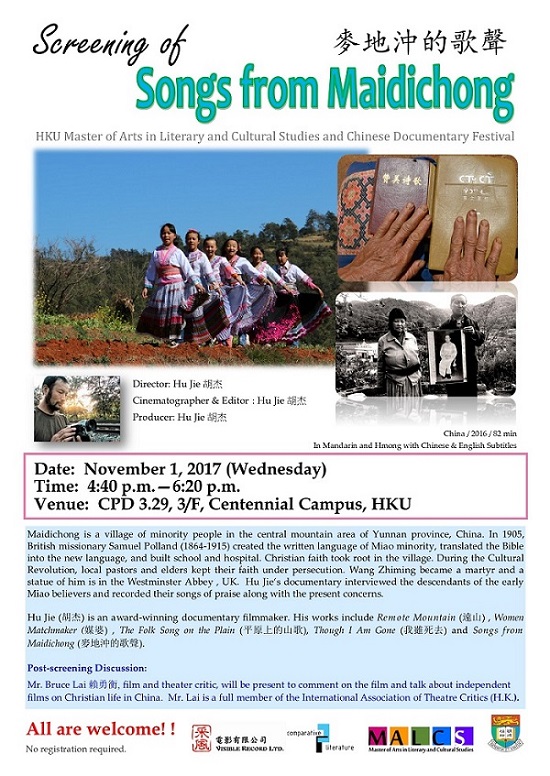
Maidichong is a village of minority people in the central mountain area of Yunnan province, China. In 1905, British missionary Samuel Polland (1864-1915) created the written language of Miao minority, translated the Bible into the new language, and built school and hospital. Christian faith took root in the village. During the Cultural Revolution, local pastors and elders kept their faith under persecution. Wang Zhiming became a martyr and a statue of him is in the Westminster Abbey , UK. Hu Jie’s documentary interviewed the descendants of the early Miao believers and recorded their songs of praise along with the present concerns.
Hu Jie (胡杰) is an award-winning documentary filmmaker. His works include Remote Mountain (遠山) , Women Matchmaker (媒婆) , The Folk Song on the Plain (平原上的山歌), Though I Am Gone (我雖死去) and Songs from Maidichong (麥地沖的歌聲).
Post-screening Discussion: Mr. Bruce Lai 賴勇衡, film and theater critic will be present to comment on the film and talk about independent films on Christian life in China. Mr. Lai is a full member of the International Association of Theatre Critics (Hong Kong).
Speakers: Prof. Asuman Suner (Department of Humanities and Social Sciences in Istanbul Technical University)
Date: 31 October 2017 (Tue) Time: 5:00pm-6:30pm Venue: 4.36, Run Run Shaw Tower, Centennial Campus, HKU
About the Seminar:
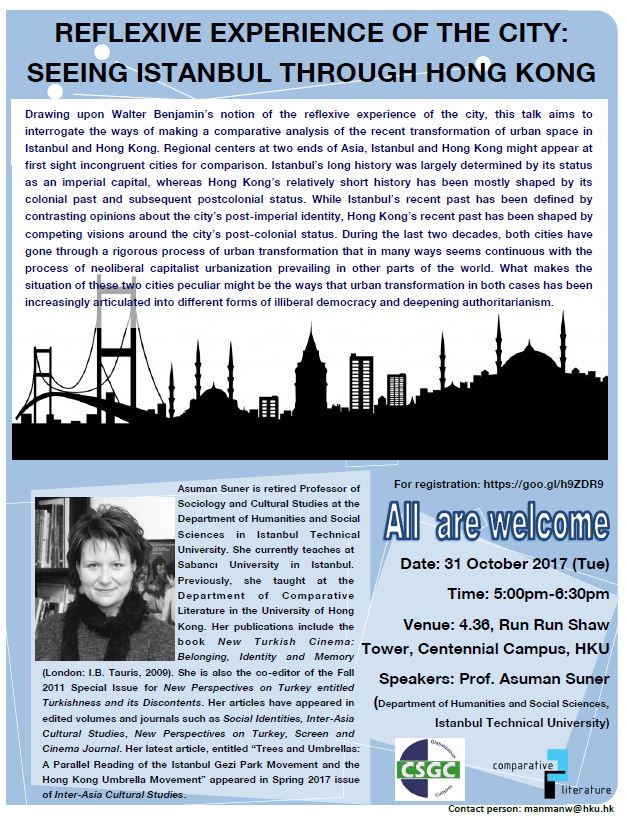
Drawing upon Walter Benjamin’s notion of the reflexive experience of the city, this talk aims to interrogate the ways of making a comparative analysis of the recent transformation of urban space in Istanbul and Hong Kong. At first sight, Istanbul and Hong Kong, regional centers at two sides of Asia, might appear incongruent cities for comparison. Never having been formally colonized, Istanbul’s long history was mostly determined by its status as an imperial capital – of the East Roman, Byzantine and Ottoman Empires, respectively. By contrast, Hong Kong’s relatively short history has been mostly shaped by its colonial past and subsequent postcolonial status. While Istanbul’s recent past has been defined by contrasting opinions about the city’s postimperial identity, Hong Kong’s recent past has been shaped by competing visions around the city’s post-colonial status. During the last two decades, both cities have gone through a rigorous process of urban transformation that brought about what David Harvey calls increasing “commodification of the quality of urban life” and the redefinition of the city as a site of consumerism. While the transformation in Hong Kong is sometimes depicted as “bulldozer style development,” the present–day Istanbul has turned into a “city of cranes” because of its non-ending frenzy of construction. In both cases, the recent neoliberalization of urban space gave rise to a new wave of urban activism against the demolition of historic neighborhoods, implementation of massive urban projects, commodification of urban space, and the disappearance of street culture. On the one hand, the recent transformation of Istanbul and Hong Kong seems continuous with the process of neoliberal capitalist urbanization prevailing in other parts of the world. What makes the situation of these two cities peculiar might be the ways that urban transformation in both cases has been increasingly articulated into different forms of illiberal democracy and deepening authoritarianism.
About the Speaker:
Asuman Suner is retired Professor of Sociology and Cultural Studies at the Department of Humanities and Social Sciences in Istanbul Technical University. She currently teaches at Sabanci University in Istanbul. Previously, she taught at the Department of Comparative Literature in the University of Hong Kong. Her publications include the book New Turkish Cinema: Belonging, Identity and Memory (London: I.B. Tauris, 2009). She is also the co-editor of the Fall 2011 Special Issue for New Perspectives on Turkey entitled Turkishness and its Discontents. Her articles have appeared in edited volumes and journals such as Social Identities, Inter-Asia Cultural Studies, New Perspectives on Turkey, Screen and Cinema Journal. Her latest article, entitled “Trees and Umbrellas: A Parallel Reading of the Istanbul Gezi Park Movement and the Hong Kong Umbrella Movement” appeared in Spring 2017 issue of Inter-Asia Cultural Studies.
Date: 26 October, 2017 (Thursday) Time: 18:00-20:00 Venue: Rm. 4.36, Run Run Shaw Tower, Centennial Campus, HKU
Moderator: Prof. Gina Marchetti (Department. of Comparative Literature; Committee on Gender Equality and Diversity)
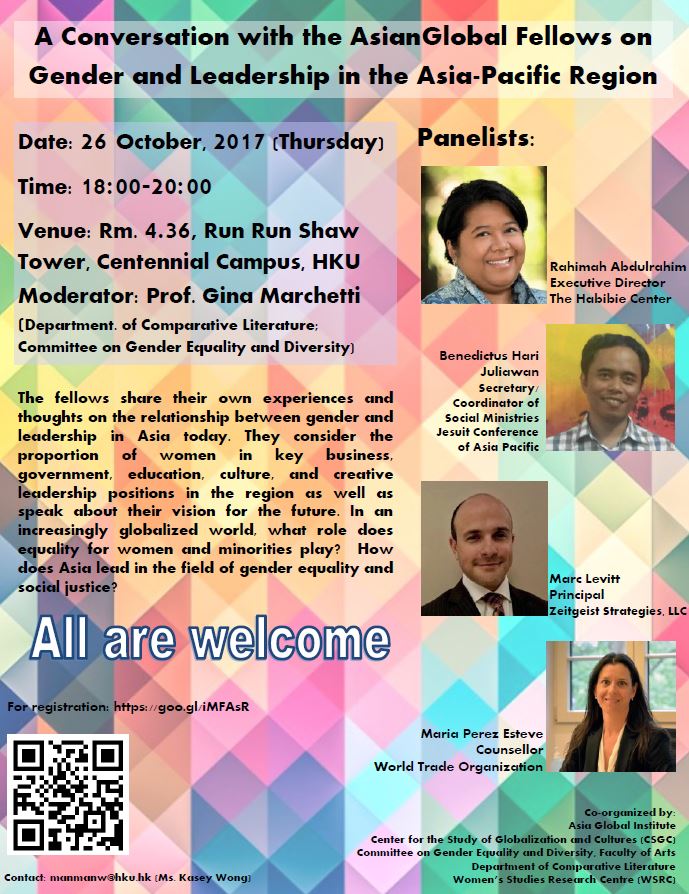
Panelists: Rahimah Abdulrahim (Executive Director, The Habibie Center) Benedictus Hari Juliawan (Secretary/Coordinator of Social Ministries, Jesuit Conference of Asia Pacific) Marc Levitt (Principal, Zeitgeist Strategies, LLC) Maria Perez Esteve (Counsellor, World Trade Organization)
The fellows share their own experiences and thoughts on the relationship between gender and leadership in Asia today. They consider the proportion of women in key business, government, education, culture, and creative leadership positions in the region as well as speak about their vision for the future. In an increasingly globalized world, what role does equality for women and minorities play? How does Asia lead in the field of gender equality and social justice?
Co-organized by: Asia Global Institute Center for the Study of Globalization and Cultures (CSGC) Committee on Gender Equality and Diversity, Faculty of Arts Department of Comparative Literature Women’s Studies Research Centre (WSRC)