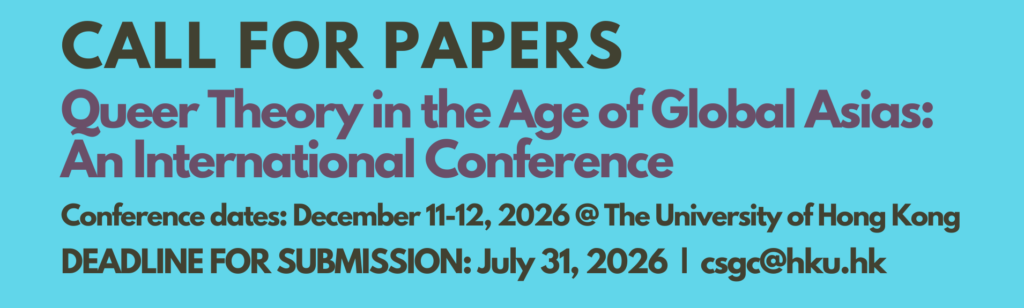
December 11-12, 2026 | University of Hong Kong
Deadline: submit an abstract of 200 words and a 2-page CV by July 31, 2026 at csgc@hku.hk
Travel and accommodation: we will do our best to provide partial accommodation for conference participants (subject to budgetary consideration). We are unable to cover airfare. Registration is free for all conference participants. Lunch and dinner will be provided for presenters.
Acceptance and notification: acceptance of conference papers will be notified by August 31, 2026.
Conference organizers: Jack Halberstam (Columbia University) and Alvin K. Wong (University of Hong Kong).
Keynote speaker: Denise Tang, Associate Professor and Head, Department of Cultural Studies (Lingnan University).
In the last two decades, queer theory has shifted from theoretical focuses on shame, performativity, and identification to questions of transnationalism, diaspora, queer liberalism, homonormativity, and homonationalism. Simultaneously, when US-based queer theorists (Eng, Ferguson, Gopinath, Munoz, etc.) devised new models such as queer of color critique and queer diaspora to name the alternative subjectivities and telos of modernity beyond queer liberalism, the AsiaPacifiQueer (APQ) network based in Australia collaborated with queer scholars in Asia to organize the First International Conference of Asian Queer Studies in Bangkok in July 2005. The intellectual work of queer Asian studies can be summarized by the statement by Fran Martin, Peter A. Jackson, Mark McLelland, and Audrey Yue in their coedited volume, AsiaPacifiQueer: “Since it was established in 2000, the aim of APQ has been to…inscribe queer studies within Asian studies and equally importantly to locate Asia, and the non-West, within queer studies.” Scholars affiliated with queer Asian studies have subsequently expanded this call in several directions. On the one hand, Petrus Liu theorizes queer Marxism in the two Chinas as offering a non-liberal critique of Western queer theory. Liu thinks through the difference that it makes to theorize queerness in relation to a history of communist struggle in China. If materialist approaches to the past have tended to ignore gender, sexuality, and race, he proposes, then queer theory is often guilty of skirting the subject of class. Together they form a “polarity,” Liu notes, “between the old class politics and the new identity politics.” And where queer theory does examine class, it tends to do so with a guilty conscience, substituting “a moralizing language against privilege or discrimination” in place of systematic materialist analysis. This difference is so important to casting “Asia” as not a territorial difference but an actual ideological shift that changes the kinds of questions we might ask.
Meanwhile, scholars of queer Sinophone studies such as Howard Chiang, Alvin K. Wong, Lily Wong, and others have engaged with the Transpacific, the Sinophone, and queer regionalism as powerful analytical frames to disrupt China-centric models of area studies. More recently, critics such as Ying-Chao Kao and Wen Liu have demonstrated how an uncritical exporting of US-based concepts of homonationalism and homonormativity in fact reproduces the coloniality of queer theory in its refusal to recognize bottom-up struggles in LGBTQ+ civil rights in contemporary Taiwan. Similarly, Audrey Yue and Jun Zubillaga-Pow have urged queer Asian scholars to understand the illiberal pragmatism in “postcolonial” and capitalist countries and states such as Singapore, in which political illiberalism works in tandem with the emergence of vibrant queer public cultures. The recent scholarship on queer Asian media and platforms by Jamie J. Zhao, Liang Ge, Tan Jia, Shana Ye, and others demonstrate that queer Asian mediality can thrive in national spaces that are deemed as non-liberal, if not authoritarian. The heterogenous modes in which queerness thrives in non-metropolitan, non-liberal, and Asian regional contexts recalls Evelyn Blackwood’s keen observation that second and third-tier regions like Padang might be the most interesting place to study how the global flow of LGBTQ knowledge meets with translocal articulations of genders and sexualities in Indonesia. Recent journals’ special issues on the concept of “queer Asias” also invoke border-crossing at both topical and conceptual levels. Michelle Ho and Evelyn Blackwood write, “In using the term ‘Queer Asias,’ we refer to such multidirectional crossing—both the acts of crossing over and crossing back—that transpinays, joso individuals, and tomboy migrant domestic workers constantly engage in.”
This conference expands the groundbreaking scholarship on queer Asias by inviting participants to present works that further shake up the field. Presenters might consider (but should not limit themselves to) the following topics and questions:
- How do models of queer genders, sexualities, and embodiments in Central, East, Southeast, and South Asias challenge Western hegemonic articulations of LGBTQ? (Examples: lesbi, cewek, and cowok in Indonesia, TB and TGB in Hong Kong, etc).
- How have queer activists and critical legal studies scholars based in Asia devised creative frameworks to unpack the tensions between global LGBTQ human rights, colonial legal legacies, and the state’s alliance with religious and heteronormative family rights groups? What does a decolonial queer legal imaginary look like from the vantage point of global Asias?
- How might new queer Asian studies offer deep queer temporality and historicism without regurgitating the idioms of loss and archival recovery?
- How might transnational queer sociology (Travis Kong) and relational concept such as everyday erotics (Denise Tang) enable alternative theorization of queerness, Inter-Asian regionalism, and the sociological?
- How do new queer media, the moving image, and digital platforms enable alternative queer subjectivity and embodiment in global Asias?
- How might the recent convergence of Asian American Studies and Asian Studies under the rubric of global Asias engender new disciplinary alliance and solidarity with queer studies?
For updates on future events hosted by the Center for the Study of Globalization and Cultures, please visit https://www.csgc.hku.hk/
Follow us on:
– Facebook: https://www.facebook.com/csgc.hku
– Instagram: @csgc.hku