Entwined Roots, Repeated Routes – Literary History(es) Unbound between Hong Kong, Malaysia, and Taiwan: Problems of Method

Speaker: Wayne CF Yeung, Assistant Professor, University of Denver

Discussant: Nicholas Y. H. Wong, Assistant Professor, School of Chinese, HKU

Date: Thursday, 19 November 2026
Time: 5:00 pm Hong Kong Time
Venue: Room 10.69, 10/F, Run Run Shaw Tower, The University of Hong Kong

Registration link: https://hkuems1.hku.hk/hkuems/ec_hdetail.aspx?guest=Y&ueid=110027

All are welcome. Registration is required.

To have a literary history of one’s own – such is a hallmark desire of many different Sinophone locales overshadowed by China-centric historical discourses. Sinophone studies has long defined itself through localization and creolization as the conceptual linchpin for identity formation in Sinitic-language communities at the margins of China proper. Local literary history remains a contentious site within this intellectual project: the narrativization of the beginnings of local literary identity often cannot circumvent its entanglements with its putative “homeland.” Would a shift of focus to the horizontal relations between Sinophone locales help us “square the circle” of local literary historiography and achieve a “thick” historical description?

Based on a forthcoming Diacritics article about sanwen and sojourners in contemporary Taiwanese literature, this presentation tries to hypothesize Sinophone literary-historical futures through the entwined roots and repeated routes of literary diasporas and settlements between Taiwan, Hong Kong, and Malaysia. As xinzhumin (new immigrant) increasingly takes shape as part of the political idiom of Taiwan’s global multicultural governance under the shadow of cross-strait geopolitics, it also reactivates earlier memories about Sinophone Malaysian, Hong Kong, and Taiwanese writers moving between these spaces (while repressing the settler-colonial tension they may have with indigenous populations in those unceded territories). Can literary history be had from exile itself? Outlining this question as a structuring principle in contemporary Sinophone literary field, this presentation then turns towards Gigi Leung’s The Melancholy of Trees to seek answers concerning how a literary generation may reckon with the problem of futurity after deracination and transplantation.

Wayne Yeung is an assistant professor at the University of Denver. His research focuses on modern and contemporary Chinese and Sinophone literature, cinema, and cultural politics, with a comparative dimension drawn from French and Francophone studies. 
For updates on future events hosted by the Center for the Study of Globalization and Cultures, please visit https://www.csgc.hku.hk/

Follow us on:
– Facebook: https://www.facebook.com/csgc.hku
– Instagram: @csgc.hku
Places. Pieces. Spaces.: A Creative Workshop on (Science) Art Fiction

Speaker: Charlotte Mounier, artist and author

Moderator: Daniel Elam, Comparative Literature, HKU

Respondent: Alex Mecattaf, architect and designer

Date: 5 November 2026 (Thursday)
Time: 3-6 pm, Hong Kong time
Venue: Room 438, 4/F, Run Run Shaw Tower, The University of Hong Kong

Registration: Please email Daniel Elam at jdelam@hku.hk by 1 November 2026. Participation is limited to 10 attendees and places will be allocated on a first-come, first-served basis.

The “Places. Pieces. Spaces.” workshop would explore (science) art fiction: how the places we inhabit shape our creative imagination, and how changing one condition of our reality can open up new forms of artistic creation. In this creative workshop, participants will imagine and create a fictional place (not an entire worldbuilding exercise), shaped by a new surreal condition, to invent an artwork that could only exist in this space. They would develop this through writing, before transforming it into an audio form, in coordination with the artist.

Charlotte Mounier is an artist and author, a graduate of the Sorbonne, and holds a Master’s degree in Visual Arts — Theory of Contemporary Art and Human Sciences — from Université Paris 8. She is the creator of Les Surfaces Sonores, a project initiated with the Centre Pompidou in collaboration with visually impaired people and specialised organisations. Through this work, Charlotte co-creates inclusive mediation tools using sound. Her practice is based on experimental co-creation with audiences within institutions such as the FRAC Île-de-France (Regional Contemporary Art Fund — 2026). Her career also includes research and publishing projects on graphic cultures of dissent (Graphic Cultures of Dissent, Outset Editions / Centre Pompidou). She is currently developing a project involving voice recordings co-created with the local community as part of the Villa Formose residency at the National Human Rights Museum in Taiwan.

For updates on future events hosted by the Center for the Study of Globalization and Cultures, please visit https://www.csgc.hku.hk/

Follow us on:
– Facebook: https://www.facebook.com/csgc.hku
– Instagram: @csgc.hku
Podcasting and/as Obsession

Speaker: Neil Verma, Associate Professor, Northwestern University

Moderator: Jean Ma, Mr. and Mrs. Hung Hing-Ying Professor in the Arts

Date: Wednesday, October 21, 2026

Time: 5:00 pm Hong Kong Time

Venue: CPD-1.24, The University of Hong Kong

Registration link: https://hkuems1.hku.hk/hkuems/ec_hdetail.aspx?guest=Y&ueid=109987

All are welcome. Registration is required.

What does it mean to stand in obsessive relation to an object? What does it mean to narrate that relation mimetically? Drawing on research into hundreds of U.S. audio podcasts of the 2010s, this paper historicizes and theorizes the rise of obsession as a theme and method in a wide variety of true crime, audio drama and storytelling podcasts. Introducing methodologies of close listening as well as approaches to mapping obsessive relationships structurally, this talk also turns the question back on itself, asking what happens when, rather than demystifying obsession, a critic elects to embrace it.  

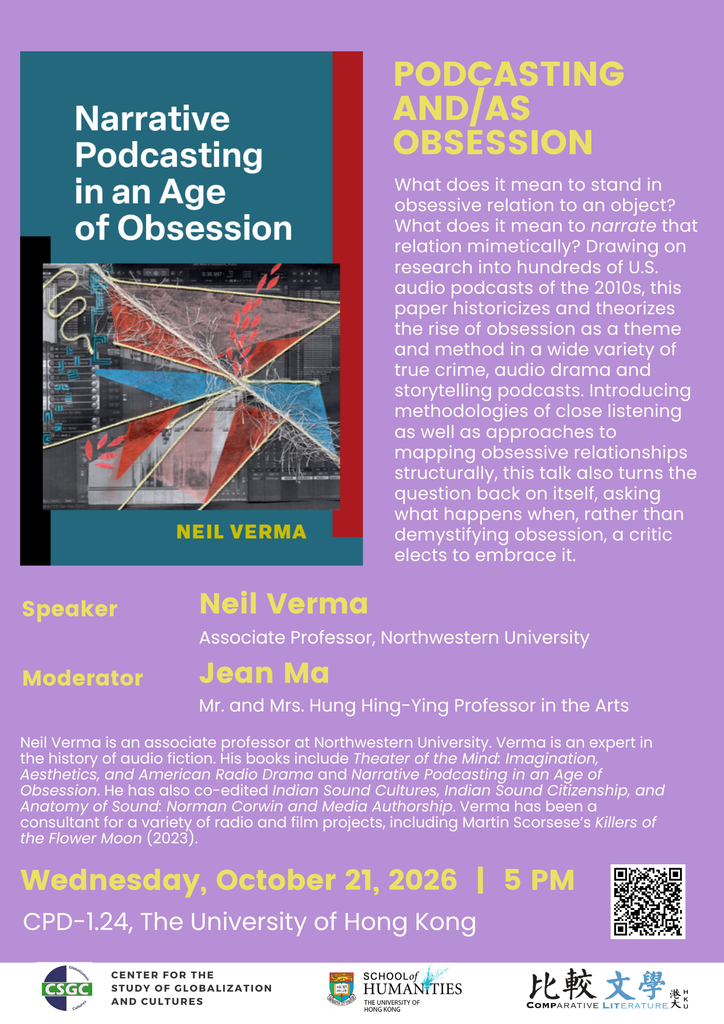
Neil Verma is an associate professor at Northwestern University. Verma is an expert in the history of audio fiction. His books include Theater of the Mind: Imagination, Aesthetics, and American Radio Drama and Narrative Podcasting in an Age of Obsession. He has also co-edited Indian Sound Cultures, Indian Sound Citizenship, and Anatomy of Sound: Norman Corwin and Media Authorship. Verma has been a consultant for a variety of radio and film projects, including Martin Scorsese’s Killers of the Flower Moon (2023).

For updates on future events hosted by the Center for the Study of Globalization and Cultures, please visit https://www.csgc.hku.hk/

Follow us on:
– Facebook: https://www.facebook.com/csgc.hku
– Instagram: @csgc.hku
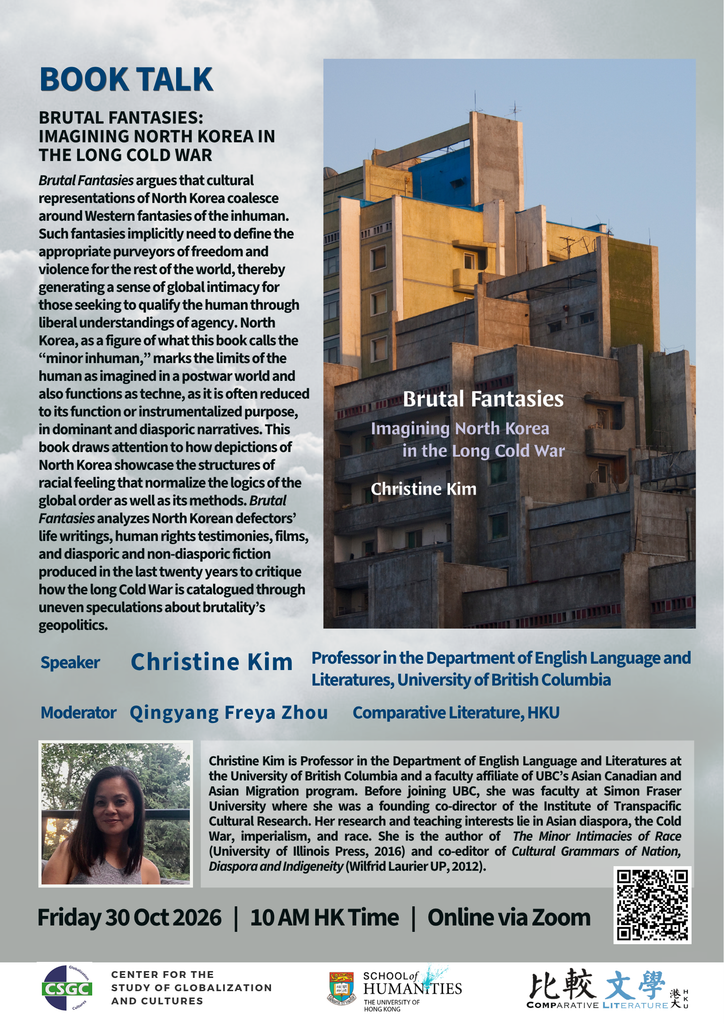
[Book Talk] Brutal Fantasies: Imagining North Korea in the Long Cold War 

Speaker: Christine Kim, Professor, Department of English Language and Literatures, University of British Columbia

Moderator: Qingyang Freya Zhou, Comparative Literature, HKU

Date: Friday, October 30, 2026

Time: 10am Hong Kong time

Venue: on Zoom

Registration link: https://hkuems1.hku.hk/hkuems/ec_hdetail.aspx?guest=Y&ueid=109825

All are welcome. Registration required.

Brutal Fantasies argues that cultural representations of North Korea coalesce around Western fantasies of the inhuman. Such fantasies implicitly need to define the appropriate purveyors of freedom and violence for the rest of the world, thereby generating a sense of global intimacy for those seeking to qualify the human through liberal understandings of agency. North Korea, as a figure of what this book calls the “minor inhuman,” marks the limits of the human as imagined in a postwar world and also functions as techne, as it is often reduced to its function or instrumentalized purpose, in dominant and diasporic narratives. This book draws attention to how depictions of North Korea showcase the structures of racial feeling that normalize the logics of the global order as well as its methods. Brutal Fantasies analyzes North Korean defectors’ life writings, human rights testimonies, films, and diasporic and non-diasporic fiction produced in the last twenty years to critique how the long Cold War is catalogued through uneven speculations about brutality’s geopolitics. It also resists methodological tendencies to simplify North Korea through Cold War binaries by directing attention instead towards North Korea as a site of contradiction that complicates the interpretative constraints of the West. Foregrounding key affective turns in North Korean representation (such as disbelief, fear, and sadness), this book’s chapters collectively disrupt fantasies of the North Korean inhuman by providing alternate ways of situating North Korea within global and regional imaginaries.

Christine Kim is Professor in the Department of English Language and Literatures at the University of British Columbia and a faculty affiliate of UBC’s Asian Canadian and Asian Migration program. Before joining UBC, she was faculty at Simon Fraser University where she was a founding co-director of the Institute of Transpacific Cultural Research. Her research and teaching interests lie in Asian diaspora, the Cold War, imperialism, and race. She is the author of Brutal Fantasies: Imagining North Korea in the Long Cold War (Duke UP, 2025), The Minor Intimacies of Race (University of Illinois Press, 2016) and co-editor of Cultural Grammars of Nation, Diaspora and Indigeneity (Wilfrid Laurier UP, 2012).

For updates on future events hosted by the Center for the Study of Globalization and Cultures, please visit https://www.csgc.hku.hk/

Follow us on:
– Facebook: https://www.facebook.com/csgc.hku
– Instagram: @csgc.hku
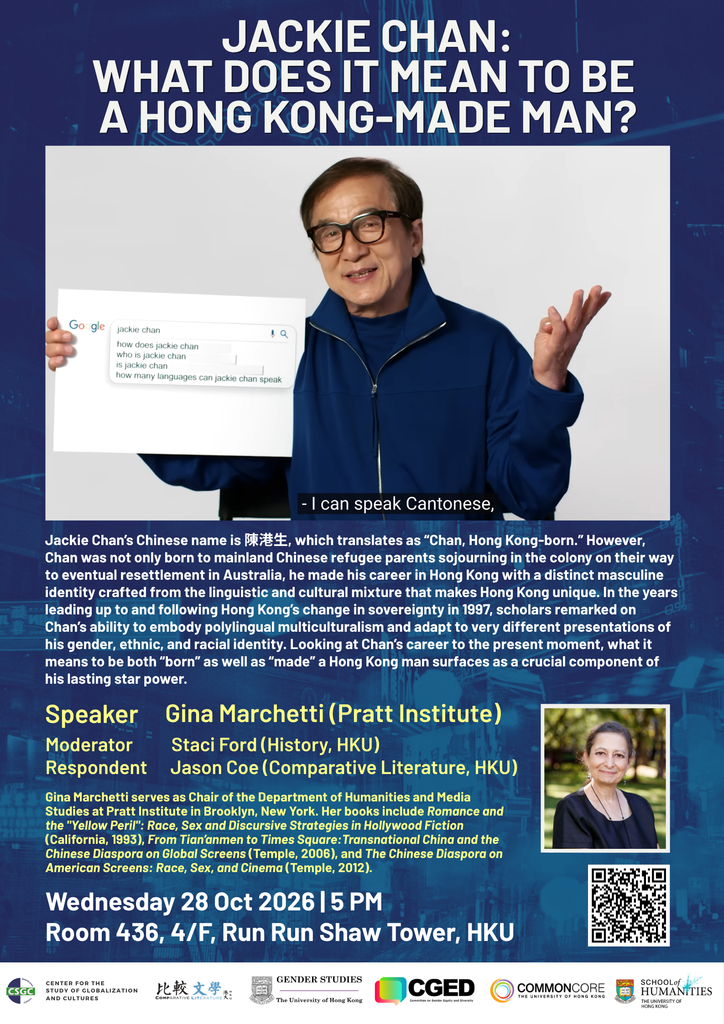
Jackie Chan:  What Does It Mean to Be a Hong Kong-Made Man?

Speaker: Gina Marchetti (Pratt Institute)

Moderator: Staci Ford (History, HKU)

Respondent: Jason Coe (Comparative Literature, HKU)


Date: Wednesday, October 28, 2026
Time: 5:00 pm Hong Kong Time
Venue:
Room 436, 4/F, Run Run Shaw Tower, The University of Hong Kong

All are welcome. Registration is required.

Registration link: https://hkuems1.hku.hk/hkuems/ec_hdetail.aspx?guest=Y&ueid=109802

Jackie Chan’s Chinese name is 陳港生 (Chan Kong-sang in Cantonese, Chen Gangsheng in Mandarin), which translates as “Chan, Hong Kong-born.”  However, Chan was not only born to mainland Chinese refugee parents sojourning in the colony on their way to eventual resettlement in Australia, he made his career in Hong Kong with a distinct masculine identity crafted from the linguistic and cultural mixture that makes Hong Kong unique.  In the years leading up to and following Hong Kong’s change in sovereignty in 1997, scholars remarked on Chan’s ability to embody polylingual multiculturalism and adapt to very different presentations of his gender, ethnic, and racial identity.  Looking at Chan’s career to the present moment, what it means to be both “born” as well as “made” a Hong Kong man surfaces as a crucial component of his lasting star power.  

Gina Marchetti serves as Chair of the Department of Humanities and Media Studies at Pratt Institute in Brooklyn, New York.  Her books include Romance and the “Yellow Peril”: Race, Sex and Discursive Strategies in Hollywood Fiction (California, 1993), From Tian’anmen to Times Square:  Transnational China and the Chinese Diaspora on Global Screens  (Temple, 2006), The Chinese Diaspora on American Screens:  Race, Sex, and Cinema (Temple, 2012), Andrew Lau and Alan Mak’s Infernal Affairs—The Trilogy (HKUP, 2007), Citing China:  Politics, Postmodernism, and World Cinema (Hawai’i, 2018), and Women Filmmakers and the Visual Politics of Transnational China in the #MeToo Era (Amsterdam, 2024). 

For updates on future events hosted by the Center for the Study of Globalization and Cultures, please visit https://www.csgc.hku.hk/

Follow us on:
– Facebook: https://www.facebook.com/csgc.hku
– Instagram: @csgc.hku