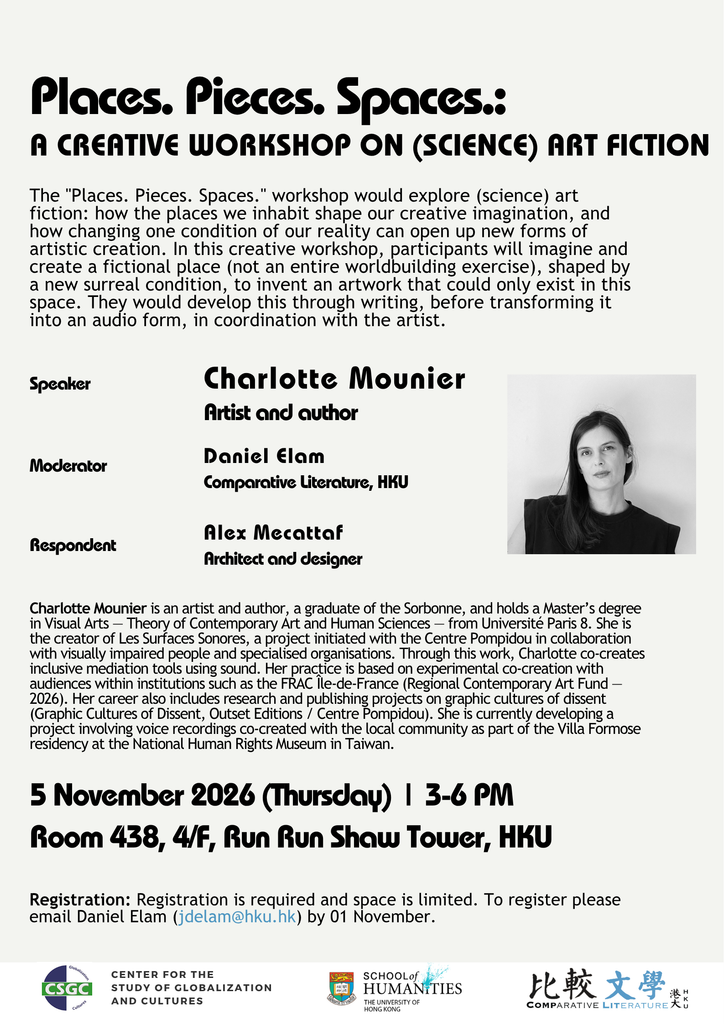
Date: 5 November 2026 (Thursday) Time: 3-6 pm, Hong Kong time Venue: Room 438, 4/F, Run Run Shaw Tower, The University of Hong Kong
Registration: Please email Daniel Elam at jdelam@hku.hk by 1 November 2026. Participation is limited to 10 attendees and places will be allocated on a first-come, first-served basis.
The “Places. Pieces. Spaces.” workshopwould explore (science) art fiction: how the places we inhabit shape our creative imagination, and how changing one condition of our reality can open up new forms of artistic creation. In this creative workshop, participants will imagine and create a fictional place (not an entire worldbuilding exercise), shaped by a new surreal condition, to invent an artwork that could only exist in this space. They would develop this through writing, before transforming it into an audio form, in coordination with the artist.
Charlotte Mounier is an artist and author, a graduate of the Sorbonne, and holds a Master’s degree in Visual Arts — Theory of Contemporary Art and Human Sciences — from Université Paris 8. She is the creator of Les Surfaces Sonores, a project initiated with the Centre Pompidou in collaboration with visually impaired people and specialised organisations. Through this work, Charlotte co-creates inclusive mediation tools using sound. Her practice is based on experimental co-creation with audiences within institutions such as the FRAC Île-de-France (Regional Contemporary Art Fund — 2026). Her career also includes research and publishing projects on graphic cultures of dissent (Graphic Cultures of Dissent, Outset Editions / Centre Pompidou). She is currently developing a project involving voice recordings co-created with the local community as part of the Villa Formose residency at the National Human Rights Museum in Taiwan.
For updates on future events hosted by the Center for the Study of Globalization and Cultures, please visit https://www.csgc.hku.hk/
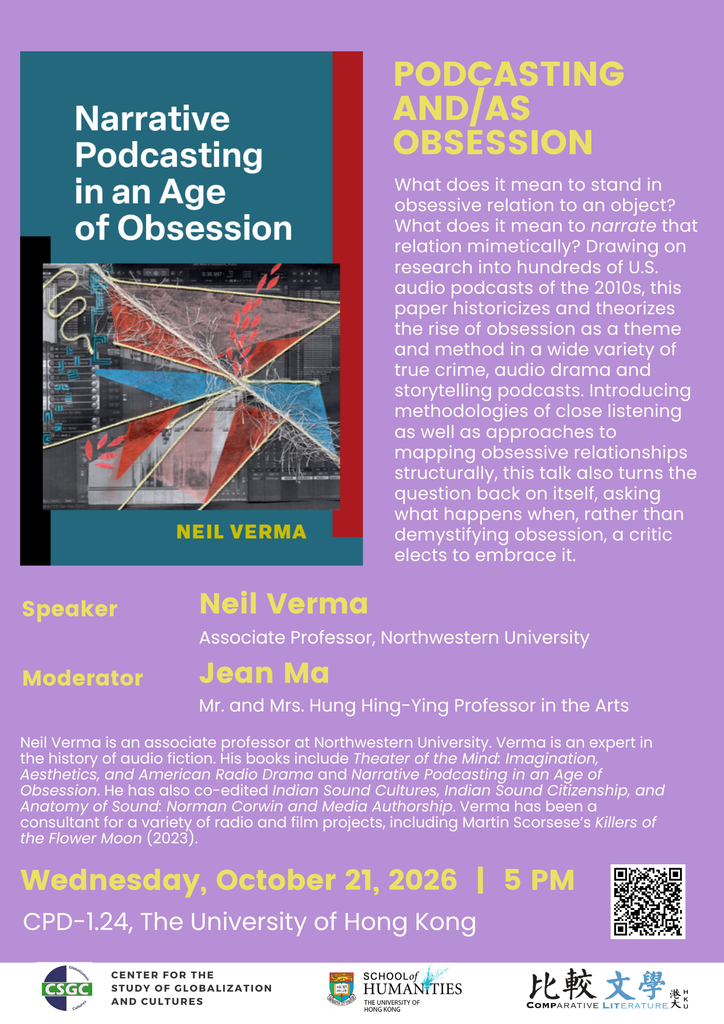
What does it mean to stand in obsessive relation to an object? What does it mean to narrate that relation mimetically? Drawing on research into hundreds of U.S. audio podcasts of the 2010s, this paper historicizes and theorizes the rise of obsession as a theme and method in a wide variety of true crime, audio drama and storytelling podcasts. Introducing methodologies of close listening as well as approaches to mapping obsessive relationships structurally, this talk also turns the question back on itself, asking what happens when, rather than demystifying obsession, a critic elects to embrace it.
Neil Verma is an associate professor at Northwestern University. Verma is an expert in the history of audio fiction. His books include Theater of the Mind: Imagination, Aesthetics, and American Radio Drama and Narrative Podcasting in an Age of Obsession. He has also co-edited Indian Sound Cultures, Indian Sound Citizenship, and Anatomy of Sound: Norman Corwin and Media Authorship. Verma has been a consultant for a variety of radio and film projects, including Martin Scorsese’s Killers of the Flower Moon (2023).
For updates on future events hosted by the Center for the Study of Globalization and Cultures, please visit https://www.csgc.hku.hk/
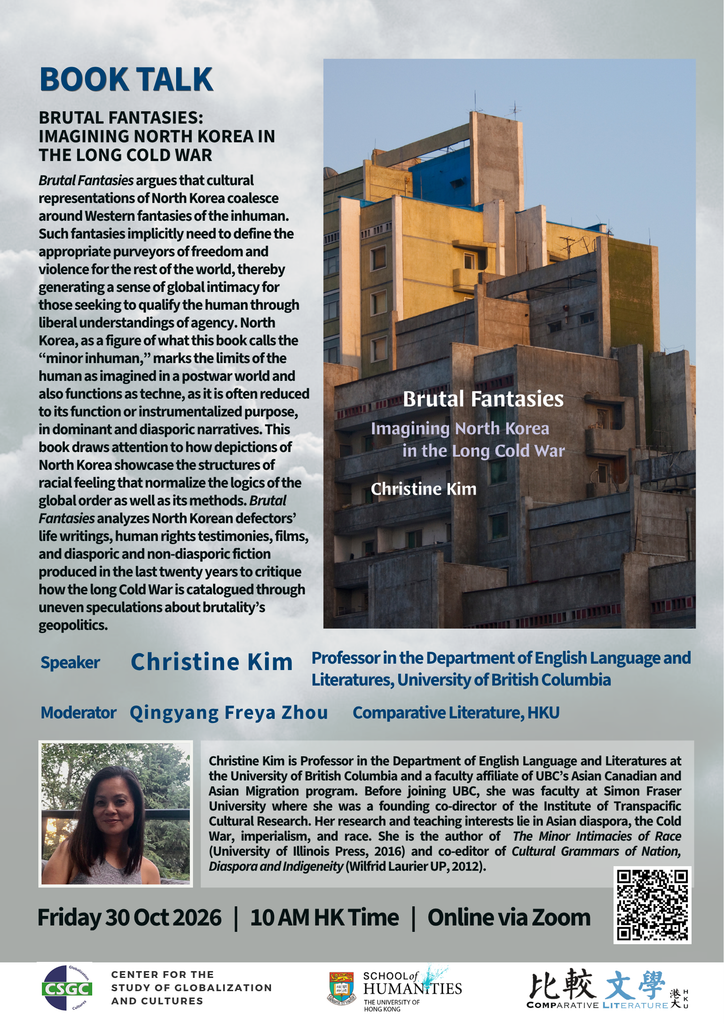
Brutal Fantasies argues that cultural representations of North Korea coalesce around Western fantasies of the inhuman. Such fantasies implicitly need to define the appropriate purveyors of freedom and violence for the rest of the world, thereby generating a sense of global intimacy for those seeking to qualify the human through liberal understandings of agency. North Korea, as a figure of what this book calls the “minor inhuman,” marks the limits of the human as imagined in a postwar world and also functions as techne, as it is often reduced to its function or instrumentalized purpose, in dominant and diasporic narratives. This book draws attention to how depictions of North Korea showcase the structures of racial feeling that normalize the logics of the global order as well as its methods. Brutal Fantasies analyzes North Korean defectors’ life writings, human rights testimonies, films, and diasporic and non-diasporic fiction produced in the last twenty years to critique how the long Cold War is catalogued through uneven speculations about brutality’s geopolitics. It also resists methodological tendencies to simplify North Korea through Cold War binaries by directing attention instead towards North Korea as a site of contradiction that complicates the interpretative constraints of the West. Foregrounding key affective turns in North Korean representation (such as disbelief, fear, and sadness), this book’s chapters collectively disrupt fantasies of the North Korean inhuman by providing alternate ways of situating North Korea within global and regional imaginaries.
Christine Kim is Professor in the Department of English Language and Literatures at the University of British Columbia and a faculty affiliate of UBC’s Asian Canadian and Asian Migration program. Before joining UBC, she was faculty at Simon Fraser University where she was a founding co-director of the Institute of Transpacific Cultural Research. Her research and teaching interests lie in Asian diaspora, the Cold War, imperialism, and race. She is the author of Brutal Fantasies: Imagining North Korea in the Long Cold War (Duke UP, 2025), The Minor Intimacies of Race (University of Illinois Press, 2016) and co-editor of Cultural Grammars of Nation, Diaspora and Indigeneity (Wilfrid Laurier UP, 2012).
For updates on future events hosted by the Center for the Study of Globalization and Cultures, please visit https://www.csgc.hku.hk/
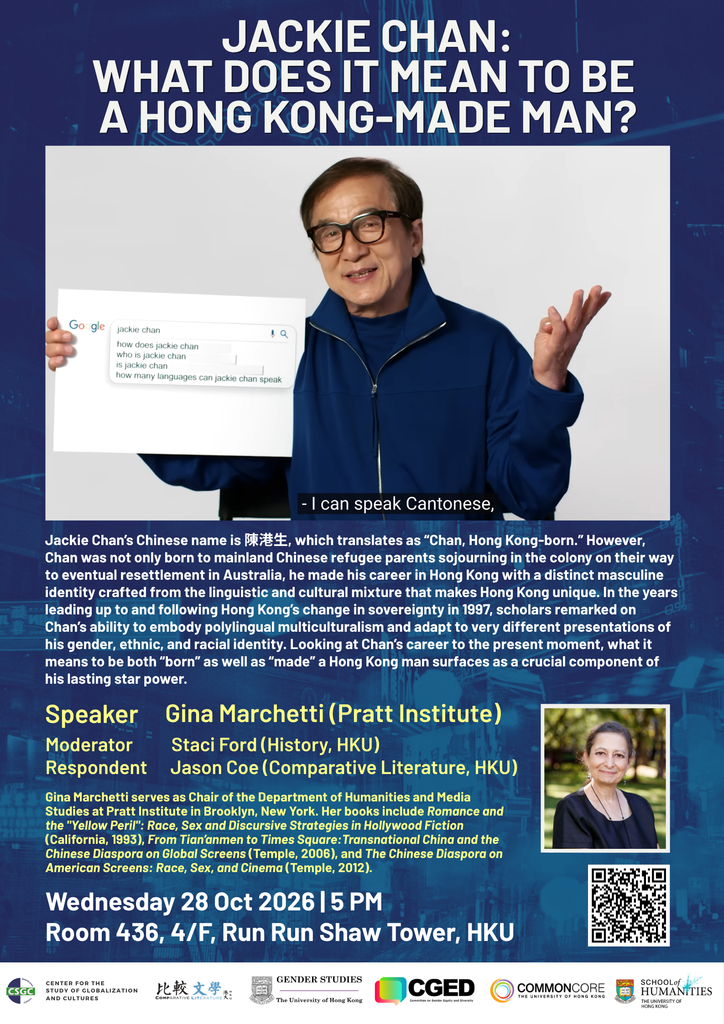
Jackie Chan’s Chinese name is 陳港生 (Chan Kong-sang in Cantonese, Chen Gangsheng in Mandarin), which translates as “Chan, Hong Kong-born.” However, Chan was not only born to mainland Chinese refugee parents sojourning in the colony on their way to eventual resettlement in Australia, he made his career in Hong Kong with a distinct masculine identity crafted from the linguistic and cultural mixture that makes Hong Kong unique. In the years leading up to and following Hong Kong’s change in sovereignty in 1997, scholars remarked on Chan’s ability to embody polylingual multiculturalism and adapt to very different presentations of his gender, ethnic, and racial identity. Looking at Chan’s career to the present moment, what it means to be both “born” as well as “made” a Hong Kong man surfaces as a crucial component of his lasting star power.
Gina Marchetti serves as Chair of the Department of Humanities and Media Studies at Pratt Institute in Brooklyn, New York. Her books include Romance and the “Yellow Peril”: Race, Sex and Discursive Strategies in Hollywood Fiction (California, 1993), From Tian’anmen to Times Square: Transnational China and the Chinese Diaspora on Global Screens (Temple, 2006), The Chinese Diaspora on American Screens: Race, Sex, and Cinema (Temple, 2012), Andrew Lau and Alan Mak’s Infernal Affairs—The Trilogy (HKUP, 2007), Citing China: Politics, Postmodernism, and World Cinema (Hawai’i, 2018), and Women Filmmakers and the Visual Politics of Transnational China in the #MeToo Era (Amsterdam, 2024).
For updates on future events hosted by the Center for the Study of Globalization and Cultures, please visit https://www.csgc.hku.hk/
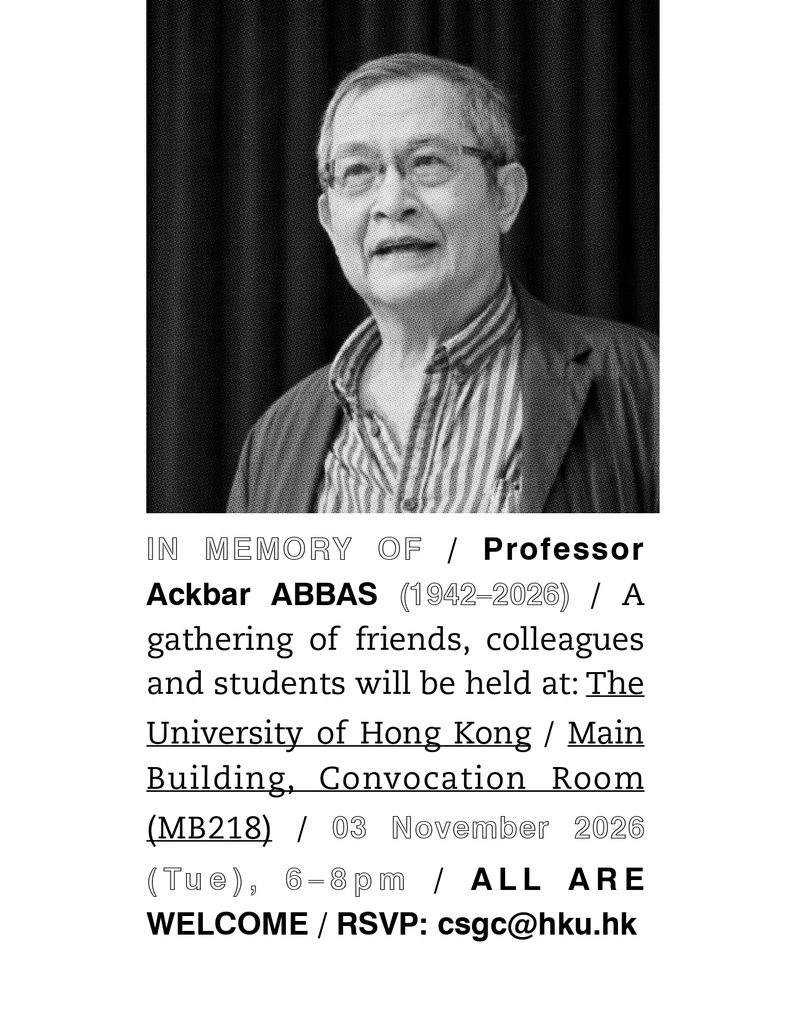
A gathering of friends, colleagues, and students will be held at HKU Main Building Convocation Room (MB218) on 03 November 2026 (Tue), 6–8pm. All are welcome.
All HKU staff and students are welcome. Registration requires HKU Portal ID.
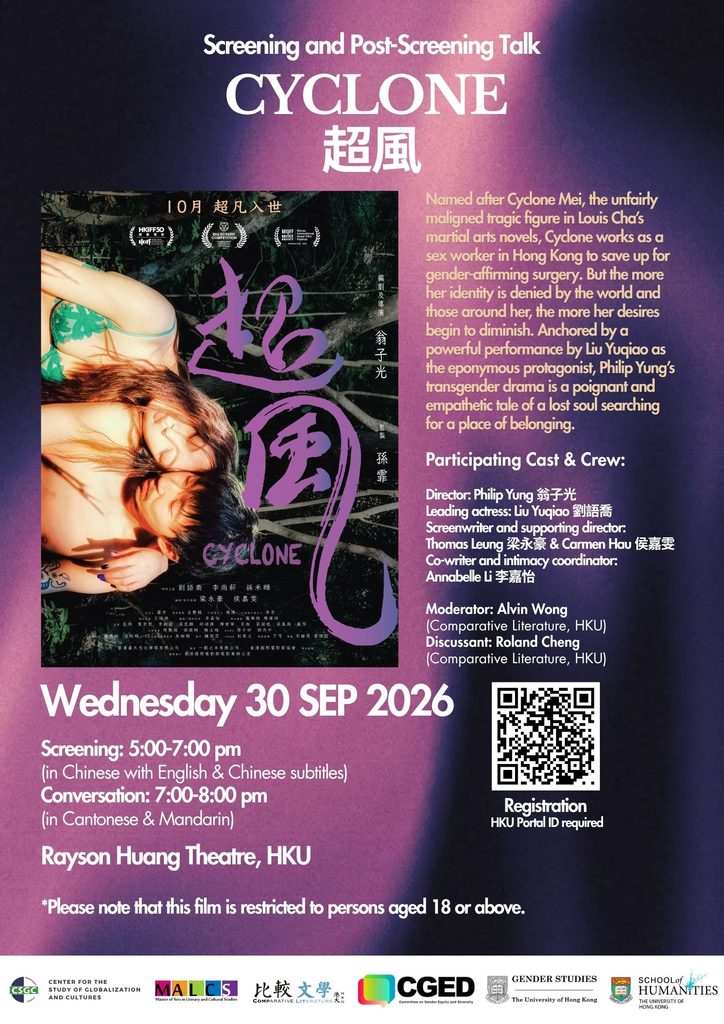
*Please note that this film is restricted to persons aged 18 or above (ID check at entrance).
About the Film
Named after Cyclone Mei, the unfairly maligned tragic figure in Louis Cha’s martial arts novels, Cyclone works as a sex worker in Hong Kong to save up for gender-affirming surgery. But the more her identity is denied by the world and those around her, the more her desires begin to diminish. Anchored by a powerful performance by Liu Yuqiao as the eponymous protagonist, Philip Yung’s transgender drama is a poignant and empathetic tale of a lost soul searching for a place of belonging.
About the Director
Philip Yung (翁子光) is a Hong Kong film director, screenwriter, and critic. He won the Hong Kong Film Award for Best Screenplay for Port of Call (2015) and was named Best Director at the 31st Hong Kong Film Critics Society Awards for Papa (2024).
Speakers & Guests
Director: Philip Yung 翁子光
Leading actress: Liu Yuqiao 劉語喬
Screenwriter and supporting director: Thomas Leung 梁永豪 and Carmen Hau 侯嘉雯
Co-writer and intimacy coordinator: Annabelle Li 李嘉怡
Speaker:Monica Macias, London College of Fashion, University of the Arts London
Moderator:Daniel Elam, Associate Professor, Comparative Literature, HKU
Date: Tuesday, September 15, 2026 Time: 5:00 pm Hong Kong Time New Venue: Room 436, 4/F, Run Run Shaw Tower, The University of Hong Kong
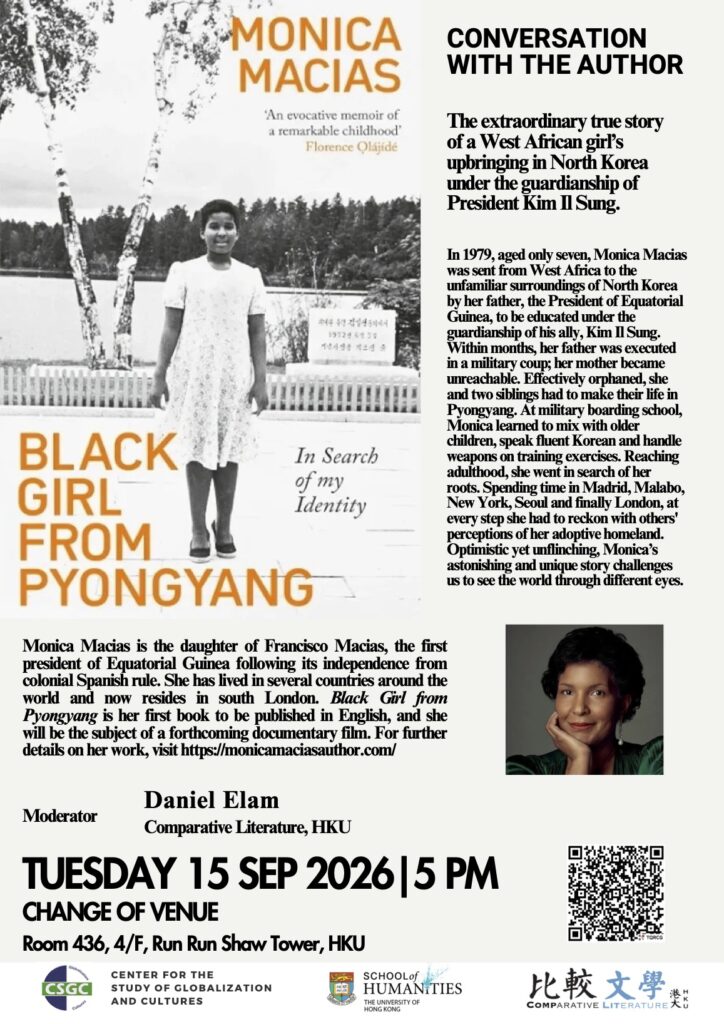
The extraordinary true story of a West African girl’s upbringing in North Korea under the guardianship of President Kim Il Sung.
In 1979, aged only seven, Monica Macias was sent from West Africa to the unfamiliar surroundings of North Korea by her father, the President of Equatorial Guinea, to be educated under the guardianship of his ally, Kim Il Sung. Within months, her father was executed in a military coup; her mother became unreachable. Effectively orphaned, she and two siblings had to make their life in Pyongyang. At military boarding school, Monica learned to mix with older children, speak fluent Korean and handle weapons on training exercises. Reaching adulthood, she went in search of her roots. Spending time in Madrid, Malabo, New York, Seoul and finally London, at every step she had to reckon with others’ perceptions of her adoptive homeland. Optimistic yet unflinching, Monica’s astonishing and unique story challenges us to see the world through different eyes.
Monica Macias is the daughter of Francisco Macias, the first president of Equatorial Guinea following its independence from colonial Spanish rule. She has lived in several countries around the world and now resides in south London. Black Girl from Pyongyang is her first book to be published in English, and she will be the subject of a forthcoming documentary film. For further details on her work, visit https://monicamaciasauthor.com/
For updates on future events hosted by the Center for the Study of Globalization and Cultures, please visit https://www.csgc.hku.hk/
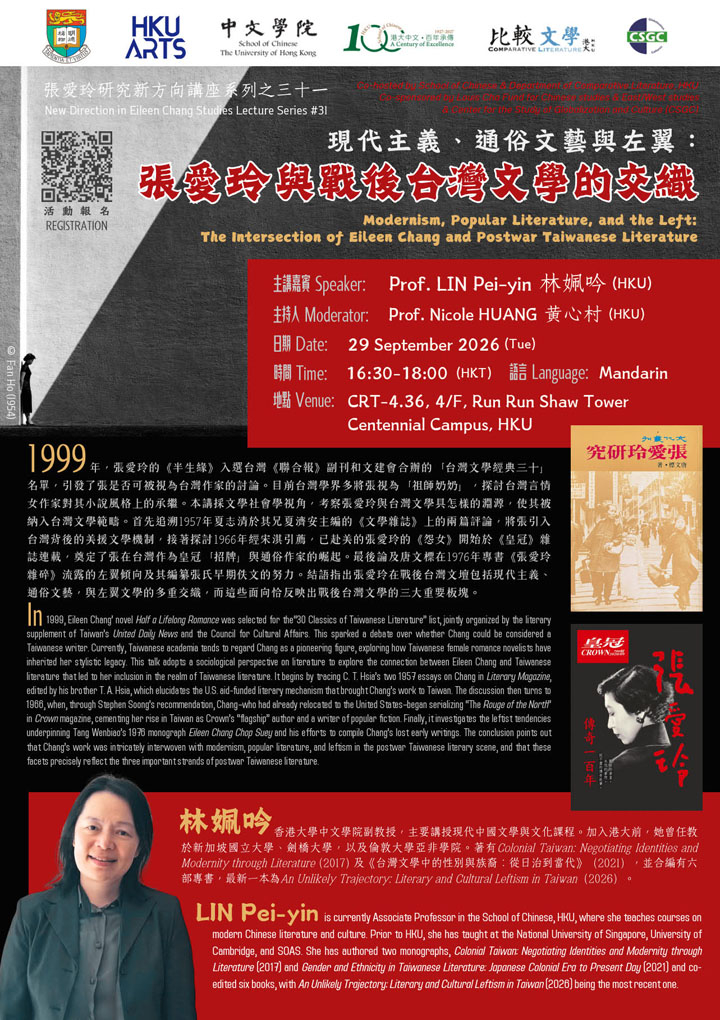
In 1999, Eileen Chang’ novel Half a Lifelong Romance was selected for the“30 Classics of Taiwanese Literature” list, jointly organized by the literary supplement of Taiwan’s United Daily News and the Council for Cultural Affairs. This sparked a debate over whether Chang could be considered a Taiwanese writer. Currently, Taiwanese academia tends to regard Chang as a pioneering figure, exploring how Taiwanese female romance novelists have inherited her stylistic legacy. This talk adopts a sociological perspective on literature to explore the connection between Eileen Chang and Taiwanese literature that led to her inclusion in the realm of Taiwanese literature. It begins by tracing C. T. Hsia’s two 1957 essays on Chang in Literary Magazine, edited by his brother T. A. Hsia, which elucidates the U.S. aid-funded literary mechanism that brought Chang’s work to Taiwan. The discussion then turns to 1966, when, through Stephen Soong’s recommendation, Chang—who had already relocated to the United States—began serializing “The Rouge of the North” in Crown magazine, cementing her rise in Taiwan as Crown’s “flagship” author and a writer of popular fiction. Finally, it investigates the leftist tendencies underpinning Tang Wenbiao’s 1976 monograph Eileen Chang Chop Suey and his efforts to compile Chang’s lost early writings. The conclusion points out that Chang’s work was intricately interwoven with modernism, popular literature, and leftism in the postwar Taiwanese literary scene, and that these facets precisely reflect the three important strands of postwar Taiwanese literature.
講者簡介 About the Speaker: 林姵吟 香港大學中文學院副教授,主要講授現代中國文學與文化課程。加入港大前,她曾任教於新加坡國立大學,劍橋大學,以及倫敦大學亞非學院。她於2015至2016年擔任哈佛燕京學者,2020年擔任萊頓大學台灣研究講座教授,並於2026年夏季擔任慕尼黑大學訪問學者。她著有 Colonial Taiwan: Negotiating Identities and Modernity through Literature (2017) 及《台灣文學中的性別與族裔:從日治到當代》(2021),並合編有六部專書,最新一本為 An Unlikely Trajectory: Literary and Cultural Leftism in Taiwan(2026)。
LIN Pei-yin is currently Associate Professor in the School of Chinese, HKU, where she teaches courses on modern Chinese literature and culture. Prior to HKU, she has taught at the National University of Singapore, University of Cambridge, and SOAS. She was a Harvard Yenching Visiting Scholar in 2015-2016, Chair of Taiwan Studies in Leiden University in 2020, and a visiting scholar at the University of Munich in the summer of 2026. She has authored two monographs, Colonial Taiwan: Negotiating Identities and Modernity through Literature (2017) and Gender and Ethnicity in Taiwanese Literature: Japanese Colonial Era to Present Day (2021) and co-edited six books, with An Unlikely Trajectory: Literary and Cultural Leftism in Taiwan (2026) being the most recent one.
Notice: 1) The seminar will be conducted primarily in face-to-face mode. Those who cannot attend the seminar in-person can apply for online participation (via Zoom) with justification. 2) All those who would like to attend the seminar are required to register online (https://hku.au1.qualtrics.com/jfe/form/SV_eap1BUFaU8hum0K) on a first-come, first-served basis. 3) A confirmation email will be sent to the registrants’ email addresses and participants have to show the screenshot or print-out version of the email for entry to the seminar venue. 4) Walk-in or latecomers will not be given entry to the seminar venue unless situation allows.
This event is held as part of the New Directions in Eileen Chang Studies Lecture Series | 張愛玲研究新方向講座系列 Co-hosted by School of Chinese and Department of Comparative Literature, HKU Co-sponsored by Louis Cha Fund for Chinese studies & East/West studies in the Faculty & Center for the Study of Globalization and Cultures (CSGC)
For updates on future events hosted by the Center for the Study of Globalization and Cultures, please visit https://www.csgc.hku.hk/
Moderator:Alvin Wong, Associate Professor, Comparative Literature, HKU
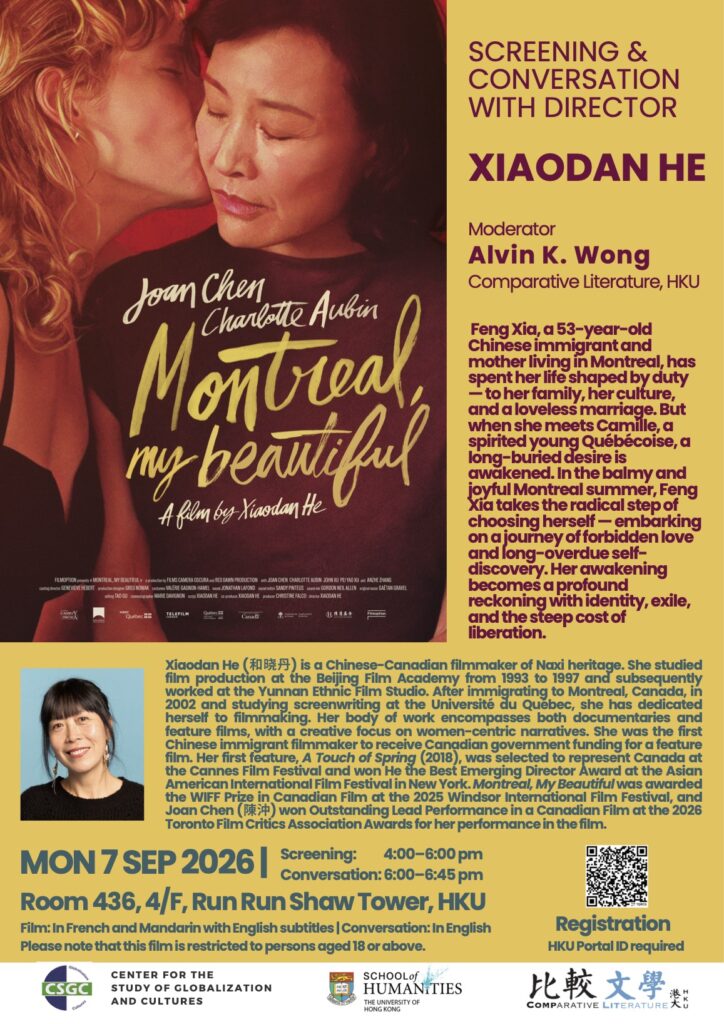
Date: Monday, September 7, 2026 Screening: 4:00-6:00 pm Hong Kong Time(In French and Mandarin with English subtitles) Conversation (in English): 6:00-6:45 pm Hong Kong Time Venue: Room 436, 4/F, Run Run Shaw Tower, The University of Hong Kong Please note that this film is restricted to persons aged 18 or above.
Feng Xia, a 53-year-old Chinese immigrant and mother living in Montreal, has spent her life shaped by duty — to her family, her culture, and a loveless marriage. But when she meets Camille, a spirited young Québécoise, a long-buried desire is awakened. In the balmy and joyful Montreal summer, Feng Xia takes the radical step of choosing herself — embarking on a journey of forbidden love and long-overdue self-discovery. Her awakening becomes a profound reckoning with identity, exile, and the steep cost of liberation.
Xiaodan He (和晓丹) is a Chinese-Canadian filmmaker of Naxi heritage. She studied film production at the Beijing Film Academy from 1993 to 1997 and subsequently worked at the Yunnan Ethnic Film Studio. After immigrating to Montreal, Canada, in 2002 and studying screenwriting at the Université du Québec, she has dedicated herself to filmmaking. Her body of work encompasses both documentaries and feature films, with a creative focus on women-centric narratives. She was the first Chinese immigrant filmmaker to receive Canadian government funding for a feature film. Her first feature, A Touch of Spring (2018), was selected to represent Canada at the Cannes Film Festival and won He the Best Emerging Director Award at the Asian American International Film Festival in New York. Montréal, My Beautiful was awarded the WIFF Prize in Canadian Film at the 2025 Windsor International Film Festival, and Joan Chen (陳沖) won Outstanding Lead Performance in a Canadian Film at the 2026 Toronto Film Critics Association Awards for her performance in the film.
For updates on future events hosted by the Center for the Study of Globalization and Cultures, please visit https://www.csgc.hku.hk/
Speaker:Gabriel Remy-Handfield, Research Assistant Professor, Academy of Language and Culture, Hong Kong Baptist University
Moderator:Arnika Fuhrmann, Professor, Comparative Literature, HKU
Date: Tuesday, September 22, 2026 Time: 5:00 pm Hong Kong Time Venue: Faculty Lounge (Room 430), 4/F, Run Run Shaw Tower, The University of Hong Kong Registration link: https://hkuems1.hku.hk/hkuems/ec_hdetail.aspx?guest=Y&ueid=109028 All are welcome. Registration is required.
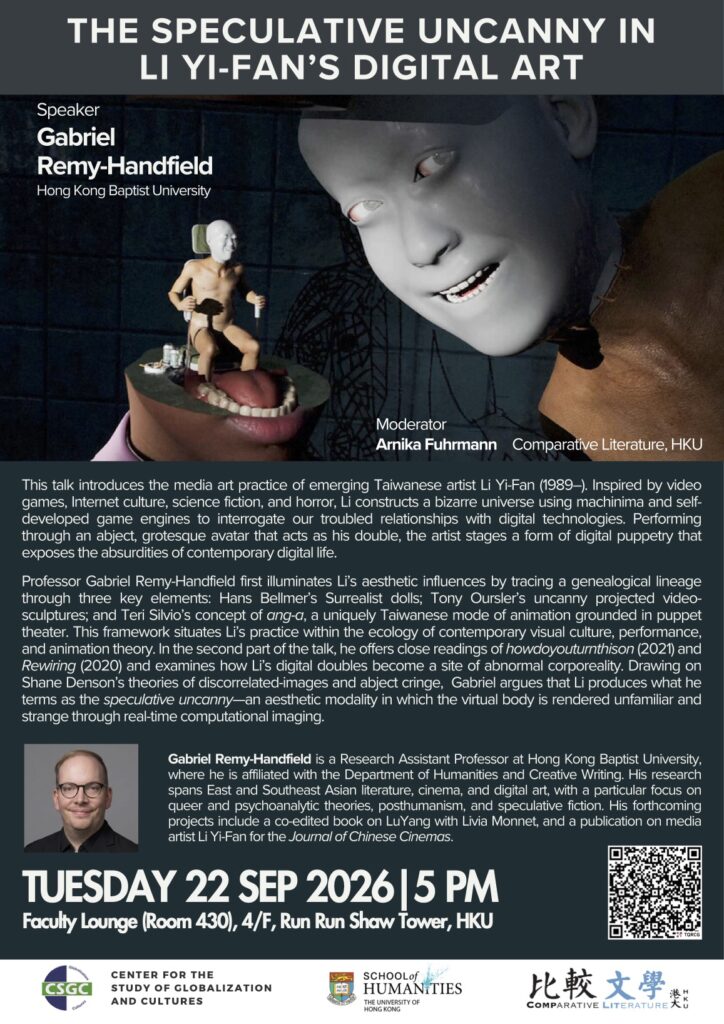
This talk introduces the media art practice of emerging Taiwanese artist Li Yi-Fan (1989–). Inspired by video games, Internet culture, science fiction, and horror, Li constructs a bizarre universe using machinima and self-developed game engines to interrogate our troubled relationships with digital technologies. Performing through an abject, grotesque avatar that acts as his double, the artist stages a form of digital puppetry that exposes the absurdities of contemporary digital life.
My talk is divided into two parts. First, I illuminate Li’s aesthetic influences by tracing a genealogical lineage through three key elements: Hans Bellmer’s Surrealist dolls, which establish a visual vocabulary of anatomical deformation and the grotesque; Tony Oursler’s uncanny projected video-sculptures; and Teri Silvio’s concept of ang-a, a uniquely Taiwanese mode of animation grounded in puppet theater. This framework situates Li’s practice within the ecology of contemporary visual culture, performance, and animation theory.
The second part offers close readings of howdoyouturnthison (2021) and Rewiring (2020) with the goal of addressing the following questions: how does the artist’s manipulation and control of virtual bodies reveal a form of uncanniness specific to our technologically mediated environment? How does he propose a new visualization of the digital body? I examine how Li’s digital doubles become a site of abnormal corporeality. Drawing on Shane Denson’s theories of discorrelated-images and abject cringe, I argue that Li produces what I term as the speculative uncanny—an aesthetic modality in which the virtual body is rendered unfamiliar and strange through real-time computational imaging.
Gabriel Remy-Handfield is a Research Assistant Professor at Hong Kong Baptist University, where he is affiliated with the Department of Humanities and Creative Writing. He holds a PhD in Comparative Literature from the University of Montreal, where his doctoral dissertation focused on media artist LuYang. Previously, he was a SSHRC Postdoctoral Fellow at the Australian National University, China Centre in the World. His research spans East and Southeast Asian literature, cinema, and digital art, with a particular focus on queer and psychoanalytic theories, posthumanism, and speculative fiction. Gabriel’s work has been published in journals such as Screen Bodies, the Journal of Chinese Film Studies, and the Journal of Contemporary Chinese Art. His forthcoming projects include a co-edited book on LuYang with Livia Monnet, and a publication on media artist Li Yi-Fan for the Journal of Chinese Cinemas.
For updates on future events hosted by the Center for the Study of Globalization and Cultures, please visit https://www.csgc.hku.hk/