Screening War in Russian and Chinese Nationalist Blockbusters 

Speaker:
Dr. Tatu-Ilari Laukkanen
, Tampere University, Finland

Moderator:
Dr. Daniel Elam
, Assistant Professor, Department of Comparative Literature, HKU

Date: Wednesday, November 1, 2023
Time: 5:00 pm (Hong Kong Time)
Venue: Room 1069, 10/F, Run Run Shaw Tower, HKU & on Zoom

In the last two decades both Chinese and Russian “blockbusterized” films about war have become some of the biggest box-office successes of all time in these countries. This presentation analyzes these Russian and Chinese nationalist blockbusters comparatively through close textual readings and pointing out industrial and politico-economic needs and practices that have given rise to these films. The dual nature of these productions as being a mimicry of and antidote to Hollywood will be discussed. Dealing mostly with films depicting the World War II era, this lecture discusses the cinematic revival of “The Great Patriotic War” under Putin, and its uses in screen culture and propaganda after Russia’s attack on Ukraine. In addition, a few recent co-productions between China and Russia will briefly be discussed in light of the two countries’ geopolitical relations.

Dr. Tatu-Ilari Laukkanen obtained his PhD in Comparative Literature at HKU and now teaches film at Tampere University and the Finnish University Network for Asian Studies (Asianet). A member of the Tampere Research Centre for Russian and Chinese Media (TaRC), he has written on film in China, Russia, and the other BRICS countries. His most recent work on Sino-Russian cinema is the upcoming book chapter, ”A Double-Edged Sword? Nationalist Blockbusters of China and Russia,” in Eastern Europe and Eurasia in the Global Age: Narrating Geopolitics and Culture,Kaasik-Krogerus et al., eds. (Bloomsbury Academic, forthcoming).

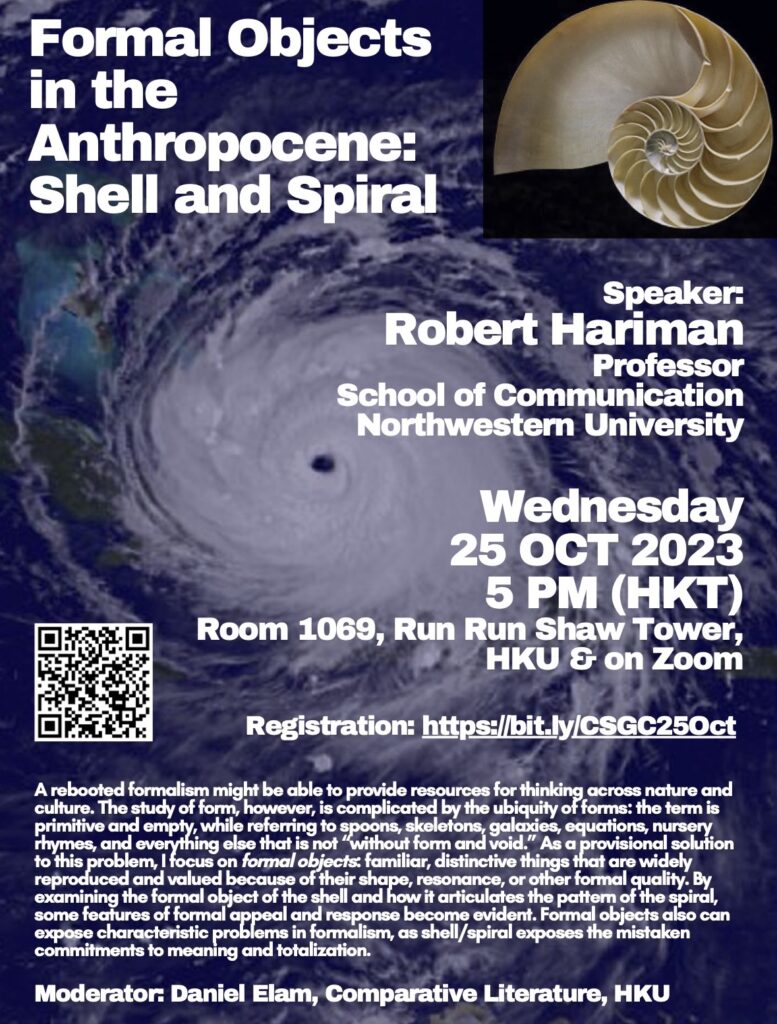
Formal Objects in the Anthropocene: Shell and Spiral

Speaker:
Robert Hariman
, Professor, School of Communication, Northwestern University

Moderator:
Daniel Elam
, Assistant Professor, Department of Comparative Literature, HKU

Date: Wednesday, October 25, 2023
Time: 5:00 pm (Hong Kong Time)
Venue: Room 1069, 10/F, Run Run Shaw Tower, HKU & on Zoom

A rebooted formalism might be able to provide resources for thinking across nature and culture. The study of form, however, is complicated by the ubiquity of forms: the term is primitive and empty, while referring to spoons, skeletons, galaxies, equations, nursery rhymes, and everything else that is not “without form and void.” As a provisional solution to this problem, I focus on formal objects: familiar, distinctive things that are widely reproduced and valued because of their shape, resonance, or other formal quality. By examining the formal object of the shell and how it articulates the pattern of the spiral, some features of formal appeal and response become evident. Formal objects also can expose characteristic problems in formalism, as shell/spiral exposes the mistaken commitments to meaning and totalization.

Robert Hariman is Professor of Communication Studies at Northwestern University. He is the author of Political Style: The Artistry of Power and of two volumes with John Louis Lucaites: No Caption Needed: Iconic Photographs, Public Culture, and Liberal Democracy, and The Public Image: Photography and Civic Spectatorship.

Fallen Pagoda, Withered Flower: Forms of Love in Eileen Chang’s Literature

倒掉的塔,凋萎的花:張愛玲文學中的愛情形式

分享嘉賓 Speaker: 濱田麻矢 教授 Prof. Maya HAMADA

主持人 Moderator: 黃心村 教授 Prof. Nicole HUANG

日期時間 Date & Time: October 25, 2023 (Wed) 16:30-18:00pm
語言 Language: Putonghua
地點 Venue (UPDATED): CPD-3.28, Central Podium Level 3, Centennial Campus, HKU

摘要 Abstract:
民國時期小說中反覆描繪的「純粹而高貴的愛情」在五四時期備受文人推崇,在戰後卻被曖昧地擱置。自由戀愛所孕育出的悖論,我們只有在張愛玲的小說,尤其是後期作品中才能看到。在象徵禮教的雷峰塔坍倒後,自由戀愛作為一種基於人類真情的、不可否認的精神活動為人們所歌頌。然而,有時候「愛」之花並不能永遠持續綻放。張愛玲不願意通過「婚姻」、「子女」等裝置來謀求愛情的持續,她認為愛情應該是「不問值不值得」的。正因如此,當她自己的專一、排他的愛情被作爲開放性關係,並成為「三美中的一美」被消費時,她的愛情只能凋萎了。本報告首先梳理自由戀愛在中國興起(封建婚姻制度衰退近似於雷峰塔坍倒)的時代背景,其次再針對隱藏在張愛玲作品中的重要因素(以西湖和白蛇傳爲中心)進行考察,探討潛藏在張愛玲心中的對於自由戀愛的複雜思考。

The “pure and noble love” repeatedly depicted during the Republican era was highly esteemed by the literati during the May Fourth age, but ambiguously shelved in the post-war period. The paradox that free love breeds can only be seen in Eileen Chang’s novels, especially in her later works. After the Fall of the Leifeng Pagoda, a symbol of ritualism, free love was celebrated as an undeniably spiritual activity based on true human feelings. However, the flower of love cannot bloom forever. Eileen Chang was unwilling to seek the continuity of love through such devices as “marriage” and “children”; she believed that love should be “without asking whether it is worth it or not”. It is for this reason that when her own exclusive love was treated as an open relationship and consumed as “one of the three beauties”, her love could only wither. This talk firstly examines the background of the rise of free love in China (the decline of the feudal marriage system is approximately equal to the Fall of the Leifeng Pagoda), and then focuses on the important factors hidden in Eileen Chang’s works (centering on the West Lake and the Legend of the White Snake), to explore the complex thoughts on free love hidden in Eileen Chang’s mind.

講者簡介 About the Speaker:
濱田麻矢 日本關西人,畢業於京都大學,文學博士。現為神户大學人文學研究科教授,主要研究對象是民國小說中的性别想像。近年出版專著《少女中國:書寫/被書寫的女學生的一百年》(『少女中国:書かれた女学生と書く女学生の百年』、岩波書店、2021),譯書有張愛玲短篇集《當中國認識愛的時候》(『中国が愛を知ったころ』岩波書店、2017)等。

Maya Hamada is Professor in Graduate School of Humanities and has worked at Kobe University since 1999. Her research interests centre on Chinese modern literature, especially female writers during 20th Century. She initially focused on the novels of the 1940s, with specific regard to the writings of Eileen Chang, but the scope of her research has since expanded significantly. She began to incorporate ‘girls’ and ‘female students’ as major keywords in her analyses. She is the author of Girl’s China: Female bildungsroman in 20th Century (Iwanami shoten, 2021).

This event is held as part of the New Directions in Eileen Chang Studies Lecture Series |
張愛玲研究新方向講座系列 
Co-hosted by School of Chinese and Department of Comparative Literature, HKU
Co-sponsored by Louis Cha Fund for Chinese studies & East/West studies in the Faculty
& Center for the Study of Globalization and Cultures (CSGC)

Screening of Shadowlands and Discussion with Producer Nida Kirmani

Moderator: Daniel Elam, Assistant Professor, Department of Comparative Literature, HKU

Date: Wednesday, September 27, 2023
Time: 5:00 pm Hong Kong Time (2:00 pm Lahore)
Venue: On Zoom

One of the oldest settlements in Karachi, Lyari has been the site on-going violence between political parties, criminal gangs and law enforcement agencies since the early 2000s. Due to this on-going conflict, Lyari has been labeled by law enforcement agencies and the media as one of several ‘no-go areas’ in the city. However, residents of Lyari tell a different story, referring to this area as ‘Karachi ki maan’ or the mother of Karachi. For Lyari’s residents, their locality has continuously shifted from being a space of protection against the hostile social and political environment of the city to a space of terror at the hands of local criminal gangs and law enforcement agencies. While the conflict has gradually subsided since 2013, the state-led Operation came with its own violence with many residents losing family members to extrajudicial killings (‘encounters’). Many others are still in prison for alleged involvement in the gangs. Furthermore, the roots of the conflict—poverty, drugs, and the conflict between political parties—remain factors that shape the area. Hence, while Lyari may officially be at ‘peace’, residents are aware the violent conflict may erupt at any time in the future. This documentary follows two residents of Lyari, both of whom have lost family members to gang violence and police encounters. Through telling their stories, the documentary sheds light on the on-going ramifications of violence and to question whether peace has truly been achieved for the people of Lyari.

Nida Kirmani – Producer
Professor Nida Kirmani is currently an Associate Professor of Sociology in the Mushtaq Ahmad Gurmani School of Humanities and Social Sciences at the Lahore University of Management Sciences. She is a leading, feminist public intellectual who has published widely on issues related to gender, Islam, women’s movements, development, and urban studies in India and Pakistan.

In the Light of the Window: Eileen Chang’s Interior Silhouette from the Revised Edition of Romances

在樓窗的燈光裡:張愛玲的家居剪影──從《傳奇》增訂本展開

分享嘉賓 Speaker: 蘇偉貞 教授 Prof. SU Wei-chen

主持人 Moderator: 林姵吟 博士 Dr. LIN Pei-yin

日期時間 Date & Time: September 27, 2023 (Wed) 16:30-18:00pm
語言 Language: Putonghua
地點 Venue: CBC, Chow Yei Ching Building, Main Campus, HKU

摘要 Abstract:
1946年11月張愛玲出版《傳奇》增訂本。序〈有幾句話同讀者說〉、跋〈中國的日夜〉、現代人窺探晚清仕女家居封面,三方定位了書寫歷程及她的境況。〈有幾句話同讀者說〉針對她的漢奸冠名辨解,漢奸之名當然來自與胡蘭成婚配,她形容兩人關係,她像棵樹,往他所在的窗前長著,「在樓窗的燈光裡也影影綽綽開著小花,但是只能在窗外窺視」;〈中國的日夜〉附了張愛玲少見結合日常生活與愛情之詩作〈落葉的愛〉,並示意了現代人窺探晚清仕女家居封面營造出她希望的不安氣氛。上述組合不離「家」關鍵詞,形構一幅張愛玲的家居剪影。關於家居追求,張愛玲曾言想要「一明兩暗」的中國風味房。她雖喜歡「明間」,但寫作以來,一路婚姻、家居,輾轉於胡蘭成到頼雅、上海到香港、美國,連帶書寫始終糾結於自傳成分的《傳奇》、《流言》之記憶變體《小團圓》、《雷峰塔》、《易經》等,從結果看過去,《傳奇》增訂本序、跋、封面似已預示了她不安的日後。晚年的她「沒有家累,沒有牽掛」,與明室絕缘。她的一生及寫作,亦可作如是觀:整個世界為張愛玲闢出了一個時空,她筆下人物進出明暗房間,走的是通道,她則以小說穿越時代。

In November 1946, Eileen Chang released a revised edition of Romances. The preface “A Few Words to the Reader,” the postscript “China’s Day and Night,” and the cover featuring a modern person peering into the home of a late Qing dynasty woman offer insight into her creative process and personal circumstances. The preface serves as a defense against the label of traitor, while the postscript features a poem that atypically blends themes of daily life and love, evoking a sense of unease that she wished to convey through the cover. All of these revolve around the keyword “home”, revealing Chang’s interior aesthetic. Despite Chang’s expressed preference for Chinese-style “one bright two dark” rooms, her marriage, life path, autobiographical works, and late self-writing suggest otherwise. In hindsight, the preface, postscript, and cover of the revised edition of Romances appear to have foreshadowed her later years, which were marked by unease. Regarding Chang’s life and writing, this talk posits that the world provided Chang with a space and time where her characters could traverse bright and dark rooms through passageways, while she traversed different eras through her fiction.

講者簡介 About the Speaker:
蘇偉貞,香港大學中文學院博士。1985年至2006年任職《聯合報》副刊,2007年起專任中國文化大學中文系、成功大學中文系等校,目前任教致理科技大學通職學部。80年代初期以《陪他一段》(1983)崛起文壇, 90年代以《沉默之島》(1994)獲《中國時報》百萬小說評審團大獎,已出版多部小說集和散文集,及學術專書《孤島張愛玲──追蹤張愛玲香港時期小說》(2002)、《描紅──台灣張派作家世代論》(2006)、《長鏡頭下的張愛玲:影像‧書信‧出版》(2011)、《不安、厭世與自我退隱──易文及同代南來文人》(2020)。

SU Wei-chen obtained her PhD from the School of Chinese, HKU. She worked at the United Daily News from 1985 to 2006. Since 2007, she has held full-time teaching positions at several universities, including the Chinese Culture University and National Cheng Kung University. Currently, she teaches at the General Education Division of Chihlee University of Technology. She rose to fame with her novel Be with Him for a While (1983), and in the 1990s, she won the China Times Literature Award for Best Novel with Island of Silence (1994). She is the author of more than a dozen volumes of fiction and nonfiction, as well as three scholarly books on Eileen Chang and one on the film director and screenwriter Yi Wen.

This event is held as part of the New Directions in Eileen Chang Studies Lecture Series |
張愛玲研究新方向講座系列 
Co-hosted by School of Chinese and Department of Comparative Literature, HKU
Co-sponsored by Louis Cha Fund for Chinese studies & East/West studies in the Faculty
& Center for the Study of Globalization and Cultures (CSGC)

Creative Self-Referencing: writing crafts for our many selves

Speaker:
Christopher B. Patterson
(aka Kawika Guillermo), Associate Professor, Social Justice Institute, University of British Columbia

Moderator:
Alvin K. Wong, Assistant Professor, Department of Comparative Literature, HKU

Date: Wednesday, September 20, 2023
Time: 10:00 am Hong Kong Time (7:00 pm/Sep 19, Vancouver)
Venue: On Zoom

This talk catalogues the author’s writing process for their prose-poetry book, Nimrods: a fake-punk self-hurt anti-memoir, using the concept of creative “self-referencing:” the way writers discover their multiple selves scattered throughout the world (and in art), and how they seek to reference them in their own work. Against forms of creative imagination that see writers as singular “voices” who express their individuality, self-referencing discloses the many others (authors, communities, kin) who influence an authors’ sense of self. For marginalized authors, self-referencing has become a resistant form of embodied cross-referencing that affirms the writer’s non-normative desires, experiences, and ways of being (and writing) by embracing their multiple points of (self)reference, and their multiple selves.

Kawika Guillermo is the author of Stamped: An Anti-travel Novel and All Flowers Bloom. Kawika Guillermo is the matrilineal name for Christopher B. Patterson, who is Associate Professor in the Social Justice Institute at the University of British Columbia and the author of Open World Empire: Race, Erotics, and the Global Rise of Video Games and Transitive Cultures: Anglophone Literature of the Transpacific.

Reflections on the Discourses of a Chinese School of Comparative Literature and a Chinese School of Film

Speaker:
Professor Sheldon LU 魯曉鵬 (UC Davis)


Moderator:
Dr. Geng SONG 宋耕 (HKU)


Date: Wednesday, August 30, 2023
Time: 11:00 am – 12:30 pm (Hong Kong Time)
Venue: CRT-7.30, 7/F, Run Run Shaw Tower, Centennial Campus, HKU

Language: English

This lecture traces the origins, development, and ramifications of two influential discourses in contemporary Chinese literary and film studies: a “Chinese school of comparative literature” and a “Chinese school of film.” While the former originated in the 1970s and continues to the present, the latter has emerged in recent years. There are similarities between the two. The lecture offers an assessment of the possible strengths and contributions of these ideas and also points out their theoretical inconsistency and blind spots. While such discourses attempt to rightfully overcome Eurocentric tendencies and promote indigenous traditions in academia, they create a new set of problems and dilemmas at the same time.

Sheldon Lu is Distinguished Professor of Comparative Literature at the University of California at Davis where he has served as Department Chair of Comparative Literature, Director of Graduate Program of Comparative Literature, and Founding Co-Director of Film Studies. He is the author, editor, and co-editor of some 15 books in English and Chinese on comparative literature, Chinese literature, and films studies. His recent books include Contemporary Chinese Cinema and Visual Culture: Envisioning the Nation (2021); Lyric Poetry and Solidarity Society in Hong Kong in the 1950s 一九五〇年代香港詞壇與堅社 (2022, in Chinese); and Ecology and Chinese-Language Cinema: Reimagining a Field (2020, co-editor).

This seminar is presented by the School of Chinese with the support of the Center for the Study of Globalization and Cultures, Department of Comparative Literature, The University of Hong Kong.

CSGC Events Fall 2023

NOV 30 | WED | 09:00 AM (HKT) | SEMINAR
Asians on Demand: A Book Launch with Dr. Feng-Mei Heberer
Moderator: Alvin K. Wong, Assistant Professor, Department of Comparative Literature, HKU

NOV 15 | WED | 05:00 PM (HKT) | SEMINAR
One and All: The Logic of Chinese Sovereignty
Speaker: Pang Laikwan, Choh-Ming Li Professor of Cultural Studies, Chinese University of Hong Kong
Moderator: Jean Ma, Professor, Department of Comparative Literature, HKU

NOV 9 | THU | 05:00 PM (HKT) | SEMINAR
The Taiwan Consensus and the Ethos of Area Studies in Pax Americana
Speaker: Jon Solomon, Professor, Department of Chinese Literature, Université Jean Moulin Lyon 3
Moderator: Daniel Vukovich, Chair, Department of Comparative Literature, HKU

NOV 1 | WED | 05:00 PM (HKT) | SEMINAR
Screening War in Russian and Chinese Nationalist Blockbusters
Speaker:Dr. Tatu-Ilari Laukkanen, Tampere University, Finland
Moderator: Daniel Elam, Assistant Professor, Department of Comparative Literature, HKU

OCT 25 | WED | 05:00 PM (HKT) | SEMINAR
Formal Objects in the Anthropocene: Shell and Spiral
Speaker: Robert Hariman, Professor, School of Communication, Northwestern University
Moderator: Daniel Elam, Assistant Professor, Department of Comparative Literature, HKU

SEP 27 | WED | 05:00 PM (HKT) | SCREENING & DISCUSSION
Screening of Shadowlands and Discussion with Producer Nida Kirmani
Moderator: Daniel Elam, Assistant Professor, Department of Comparative Literature, HKU

SEP 20 | WED | 10:00 AM (HKT) | SEMINAR
Creative Self-Referencing: writing crafts for our many selves
Speaker: Christopher B. Patterson (aka Kawika Guillermo), Associate Professor, Social Justice Institute, University of British Columbia
Moderator: Alvin K. Wong, Assistant Professor, Department of Comparative Literature, HKU

AUG 30 | WED | 11:00 AM (HKT) | SEMINAR
Reflections on the Discourses of a Chinese School of Comparative Literature and a Chinese School of Film
Speaker: Professor Sheldon LU 魯曉鵬 (UC Davis)
Moderator: Dr. Geng SONG 宋耕 (School of Chinese, HKU)

For updates on future events hosted by the Center for the Study of Globalization and Cultures, please visit https://www.csgc.hku.hk/

Follow us on:
– Facebook: https://www.facebook.com/csgc.hku
– Instagram: @csgc.hku

Love Boat: Taiwan – Screening and Discussion with the Director Valerie Soe

Moderator:
Dr. Alvin K. Wong
, Assistant Professor, Department of Comparative Literature, HKU

Date: Monday, July 3, 2023
Screening: 4:00 pm (Hong Kong Time)

Discussion: 5:10 pm (Hong Kong Time)
Venue: Room CPD3.04, Run Run Shaw Tower, HKU and ON ZOOM

This presentation examines the creation of Valerie Soe’s 2019 documentary film “Love Boat: Taiwan,” which looks at one of the longest-running cultural immersion programs in the world. The program, which is well-known in the Taiwanese American community, is sponsored by the government of Taiwan and takes place every summer in Taipei. Despite its high-minded aspirations that include classes in Mandarin-language study, martial arts, and brush painting, the program’s popularity stems from another source: its reputation as an excellent place for college-aged Taiwanese Americans to hook up and find romance. Because of this, although it does not take on a ship and is landlocked at a conference center in Taipei, the program is more commonly known by its romantic nickname – the Taiwan Love Boat.

Since its inception in the 1960s the Love Boat has served three purposes: as a propaganda tool for the Taiwanese government, as a site for romance for young Taiwanese Americans, and as a means for Taiwanese American parents to insure the preservation of Taiwanese bloodlines. Every summer this unique form of diplomacy gives young Taiwanese Americans a taste of global politics on an intimate scale. By looking at the ways in which a seemingly innocuous program can have wide-ranging political, social, and cultural repercussions, “Love Boat: Taiwan” explores the intersections of culture, politics, and history.

In addition to discussing and screening the film “Love Boat: Taiwan,” Valerie Soe will also talk about some of her award-winning short experimental films and documentaries that look at the experiences and concerns of Asian Americans.

Valerie Soe – Director, Producer & Writer
Since 1986 Valerie Soe’s experimental videos, installations, and documentary films have won dozens of awards, grants, and commissions and have exhibited at film festivals, museums, and galleries worldwide. Her short experimental video, “ALL ORIENTALS LOOK THE SAME,” won Best International Video at the 1987 Festival Internazionale Cinema Giovani, Torino, Italy, First Place, Experimental Category, at the 1987 Sony Corporation Visions of U.S. Festival, and Honorable Mention, Experimental Video, at the 12th Atlanta Film and Video Festival. Her feature documentary, “Love Boat: Taiwan,” was released in 2019 and won the Audience Award at the Urban Nomad Film Festival In Taipei, Taiwan, and has played to sold-out festival audiences across North America and in Taiwan. Her short experimental documentary, “Radical Care: The Auntie Sewing Squad” (2020), made in collaboration with Kronos Quartet and the Auntie Sewing Squad, won a Director’s Choice Award at the 2021 Thomas Edison Film Festival and the 2021 Best of Bernal Award at Bernal Heights Outdoor Cinema. Her writing has been published in books and journals including “Countervisions: Asian American Film Criticism;” “The Palgrave Handbook of Asian Cinema;” “Amerasia Journal,” and “Asian Cinema,” among many others. Soe is the author of the blog beyondasiaphilia.com (recipient of a 2011 Art Writers’ Grant, Creative Capital/Andy Warhol Foundation), which looks at Asian and Asian American art, film, culture, and activism. She is Professor of Asian American Studies at San Francisco State University.

Self-translation and the Notion of Filiality in Eileen Chang’s Fiction

Speakers: 
Prof. Christopher LUPKE (University of Alberta) & Dr. Jessica Tsui-yan LI (York University) 

Commentators: 
Dr. LIN Pei-yin & Prof. Nicole HUANG (HKU)

Date & Time: July 3, 2023 (Mon) 16:00-18:00pm
Language: English
Venue: Level 2 Multi-Purpose Area (Ingenium), Main Library, Main Campus, HKU

Topic #1: Ritual, Repression, Repetition, and Reproduction In the Fiction of Eileen Chang
This presentation considers the fiction of Eileen Chang, especially her classic short story “The Golden Cangue” (1943) in light of the grammar of filiality in Chinese society and cultural representation. One might initially think, how does Eileen Chang’s work figure into the scheme of filiality? Narrowly understood, filiality primarily means respect for one’s parents, ancestors, and privileges the vaunted role of sons in the process of biological reproduction. But when we investigate filiality more deeply, we can see that it functions in Chinese society (and all of East Asia for that matter) as a sort of grammar that has loosely scripted consanguine relations for more than two millennia. But that all changed in the modern era when filiality became the battleground in the crisis between tradition and modernity. So, how does Eileen Chang fit in? Many of her works very consciously or even obsessively linger upon the questions of marriage, biological reproduction, and intergenerational relations. “The Golden Cangue,” a story in which the main character Qiqiao is forced into a loveless marriage of convenience by her relatives for monetary gain, is perhaps the best example in modern Chinese fiction of a person once persecuted who becomes the perpetrator, someone who was a victim of feudal values and social convention who returns at a later age to inflict on her own children the same sort of abuse that was visited upon her. This disturbing fact has created one of the most fascinating caesuras in modern Chinese literature and an endless point of speculation and discussion for scholars of the modern era. What do we do when the target of mistreatment and trauma becomes one of its most adroit and gruesome offenders? Eileen Chang’s work persists in haunting our thinking and discussions precisely because of its irremediable refusal to allow us to empathize with one of its most emblematic victims.

Christopher Lupke (Ph. D. Cornell University) is Professor of Chinese Cultural Studies at the University of Alberta and former Chair of the Department of East Asian Studies. A scholar of modern and contemporary Chinese literature and cinema, his books include The Sinophone Cinema of Hou Hsiao-hsien: Culture, Style, Voice, and Motion and a translation of Ye Shitao’s monumental work, A History of Taiwan Literature, which one the Aldo and Jeanne Scaglione Prize for the translation of a scholarly book from the Modern Language Association. Christopher Lupke has edited or co-edited five books and five special journal issues, and is the recipient of the Michael Delahoyde Award for Distinguished Editing. His articles have appeared in the Journal of Asian Studiesboundary 2Comparative Literature StudiesModern Chinese Literature, and numerous other publications. Lupke’s current research project is a book-length study of the Confucian notion of “filiality” in contemporary Chinese and Sinophone fiction.

Topic #2: Eileen Chang’s Works and Self-Translation
Eileen Chang’s literary achievements are in part a result of her bilingualism and self-translation, which means that her work engages mainly with two languages and their related literary traditions, cultures, and critical traditions, although this point is overlooked in most studies of her works. As a Chinese and English bilingual writer and self-translator, Chang both preserves and transgresses the Chinese and English literary and cultural conventions that provide the larger context of this study. This talk focuses on Eileen Chang’s Chinese short story “Guihuazheng: Ah Xiao beiqiu” (1944), Chang’s self-translation into English, “Shame, Amah!” (1962), and its triangular English translation by Simon Patton, “Steamed Osmanthus Flower: Ah Xiao’s Unhappy Autumn” (2000). Dr. Jessica Tsui-yan Li will examine the in-betweenness and an interdependent relationship among these texts. She argues that the combination of Chinese and English versions presents a better picture of both Chinese and Western perspectives on gender relations and life philosophy in early twentieth-century China.

Jessica Tsui-yan Li (Ph.D. Chinese University of Hong Kong; Ph.D. University of Toronto) is Associate Professor in the Department of Languages, Literatures, and Linguistics at York University. She is Past President of the Canadian Comparative Literature Association. She has published on modern and contemporary Chinese literature, Chinese Canadian literature, film, drama, translation studies, gender studies, Hong Kong studies, and diasporic studies. She is the editor of The Transcultural Streams of Chinese Canadian Identities (McGill-Queen’s University Press 2019) and the guest editor of the special issues for the Canadian Review of Comparative LiteratureRevue Canadienne de Littérature Comparée on “Engaging Communities in Comparative Literature” June 2017 44.2 and “Garnering Diversities in Comparative Literature” June 2018 45.2. She has published several articles on Eileen Chang Studies. Her essay, “Xunfang Zhang Ailing de Xingkong” (Seeking the Starry Sky of Zhang Ailing) published in Dang’an Chunqiu (Memories and Archives) in Shanghai in 2015 received the finalist award organized by Shanghai shi dang’an guan (Shanghai Municipal Archives). She is currently working on a monograph on the self-translation of Eileen Chang.

This event is held as part of the New Directions in Eileen Chang Studies Lecture Series |
張愛玲研究新方向講座系列 
Co-hosted by School of Chinese and Department of Comparative Literature, HKU
Co-sponsored by Louis Cha Fund for Chinese studies & East/West studies in the Faculty
& Center for the Study of Globalization and Cultures (CSGC)