As Chinese performers have become more visible on global screens, their professional images – once the preserve of studios and agents – have been increasingly relayed and reworked by film fans. Web technology has made searching, poaching, editing, posting and sharing texts significantly easier, and by using a variety of seamless and innovative methods a new mode of personality construction has been developed. With case studies of high-profile stars like Jet Li, Jackie Chan and Donnie Yen, this ground-breaking book examines transnational Chinese stardom as a Web-based phenomenon, and as an outcome of the participatory practices of cyber fans.
This talk focuses on the star-making phenomenon in the backdrop of digital culture. The advent of Web technology and fan participation enable ordinary audiences of various cultural backgrounds to readily transpose filmic and publicity materials about famed figures from DVD to fan-site, from movie website to blog, realizing distinct star-fan dynamics.
Speaker’s bio: Dorothy Wai Sim Lau is an Assistant Professor at the Academy of Film, Hong Kong Baptist University. Her research interests include digital culture, cyberculture, Chinese-language cinema, transnational cinema, stardom and fandom. Her publications appear in journals such as positions: asia critique, Continuum, Journal of Chinese Cinemas, Journal of Asian Cinema, and a number of edited volumes. She is also the author of Chinese Stardom in Participatory Cyberculture (2018). She is currently writing her next monograph, Reorienting Chinese Stars in Global Polyphonic Network: Voice, Ethnicity, Power (working title) (Palgrave Macmillan, under contract).
Lesbians didn’t always get to see themselves on screen. But between Stonewall, the feminist movement, and the experimental cinema of the 1970s, they built visibility, and transformed the social imagination about queerness. Filmmakers Barbara Hammer, Su Friedrich, Rose Troche, Cheryl Dunye, Yoruba Richen, Desiree Akhavan, Vicky Du, film critic B. Ruby Rich, Jenni Olson, and others share moving and often hilarious stories from their lives and discuss how they’ve expressed queer identity through film.
For enquiries, please contact Ms. Christine Vicera at viceracn@hku.hk
Illiberal China analyzes the ‘intellectual political culture’ of post-Tiananmen China in comparison to and in conflict with liberalism inside and outside the P.R.C. How do mainland politics and discourses challenge ‘our’ own, chiefly liberal and anti-‘statist’ political frameworks? To what extent is China paradoxically intertwined with a liberal economism? How can one understand its general refusal of liberalism, as well as its frequent, direct responses to electoral democracy, universalism, Western media, and other normative forces? Vukovich argues that the Party-state poses a challenge to our understandings of politics, globalization, and even progress. To be illiberal is not necessarily to be reactionary and vulgar but, more interestingly, to be anti-liberal and to seek alternatives to a degraded liberalism. In this way Chinese politics illuminate the global conjuncture, and may have lessons in otherwise bleak times.
Advance Reviews:
“Illiberal China, from its punning title forwards, reveals how China is the objectified “other” of the West, but is also an actually existing subject with its own intrinsic logic full of paradoxes and tensions. It examines the political-economic and cultural narratives surrounding the different representations of “China,” as well as their logical boundaries and interrelationships. The book intertwines external and internal, global and domestic perspectives. At the same time, Vukovich tries to reflect critically on Western liberalism by presenting “China as a problem.” Vukovich deals frankly with many complex and sensitive topics, although this style is not an end in itself but serves to open up a new discursive space. He believes “China” challenges previous theoretical and historical narratives, especially those attached to political theory and concepts such as liberalism or democracy. This is a powerful, subtle book that challenges Chinese research from a different paradigm and theoretical system. It deserves serious attention indeed.” (Lu Xinyu, East China Normal University, China)
“Understanding today’s China is an intellectual and moral challenge. Vukovich takes it head on and makes a paradoxical case that “illiberal China” may be the best hope in this bleak moment in history. China may or may not deliver on the hope, but I am sure everyone will benefit from reading this well informed and thought-provoking study on the contemporary Chinese ideological struggle in its global context.” (Zhiyuan Cui, Tsinghua University, China)
“Liberal values and practices are supposed to be universal and China seemed to be going in the “right” direction. Until recently, that is. It now seems clear that the Chinese political system will evolve based on its own “illiberal” foundations. Vukovich’s original book argues that what he terms “progressive illiberalism” not only fits China’s political context, it is also defensible from a normative point of view. Whatever we think of his controversial argument, it will generate much-needed discussion.” (Daniel A. Bell, Shandong University and Tsinghua University, China)
Edited by Sebastian Veg Hong Kong University Press, 2019
The present volume provides an overview of new forms of popular memory, in particular critical memory, of the Mao era. Focusing on the processes of private production, public dissemination, and social sanctioning of narratives of the past in contemporary China, it examines the relation between popular memories and their social construction as historical knowledge. The three parts of the book are devoted to the shifting boundary between private and public in the press and media, the reconfiguration of elite and popular discourses in cultural productions (film, visual art, and literature), and the emergence of new discourses of knowledge through innovative readings of unofficial sources. Popular memories pose a challenge to the existing historiography of the first thirty years of the People’s Republic of China. Despite the recent backlash, these more critical reflections are beginning to transform the mainstream narrative of the Mao era in China.
Public discussions of key episodes in the history of the People’s Republic, in particular the Anti-Rightist Movement of 1957, the Great Famine of 1959–1961, and the Cultural Revolution, have proliferated in the last fifteen years. These discussions are qualitatively different from previous expressions of traumatic or nostalgic memories of Mao in the 1980s and the 1990s respectively. They reflect a growing dissatisfaction with the authoritarian control over history exercised by the Chinese state, and often they make use of the new spaces provided for counter-hegemonic narratives by social media and the growing private economy in the 2000s. Unofficial or independent journals, self-published books, social media groups, independent documentary films, private museums, oral history projects, and archival research by amateur historians, all of which analyzed in this collection, have contributed to these embryonic public or semi-public dialogues.
“An excellent guide to the independent journalism, cultural production, and amateur histories that are transforming the mainstream narrative of the Mao era in China. Rich in detail and sound in analysis, these studies document the emergence of critical memory in Chinese society. A valuable resource for students and scholars.” —Timothy Cheek, University of British Columbia; author of The Intellectual in Modern Chinese History“Popular memories of the Mao era are signposts of contemporary politics and culture. This volume features exciting new research by distinguished scholars. Extremely rich and readable, the chapters in this collection illuminate both China’s past and present. A timely and important contribution.” —Guobin Yang, University of Pennsylvania; author of The Red Guard Generation and Political Activism in China
Table of Contents Introduction: Trauma, Nostalgia, Public Debate By Sebastian Veg
Part I. Unofficial Memories in the Public Sphere: Journals, Internet, Museums
Writing about the Past, an Act of Resistance: An Overview of Independent Journals and Publications about the Mao Era By Jean-Philippe Béja
Annals of the Yellow Emperor: Reconstructing Public Memory of the Mao Era By Wu Si
Contested Past: Social Media and the Production of Historical Knowledge of the Mao Era By Jun Liu
Can Private Museums Offer Space for Alternative History? The Red Era Series at the Jianchuan Museum Cluster By Kirk A. Denton
Part II. Critical Memory and Cultural Practices: Reconfiguring Elite and Popular Discourse
Literary and Documentary Accounts of the Great Famine: Challenging the Political System and the Social Hierarchies of Memory By Sebastian Veg
Filmed Testimonies, Archives, and Memoirs of the Mao Era: Staging Unofficial History in Chinese Independent Documentaries By Judith Pernin
Visual Memory, Personal Experience, and Public History: The Rediscovery of Cultural Revolution Underground Art By Aihe Wang
Part III. Unofficial Sources and Popular Historiography: New Discourses of Knowledge on the Mao Era
The Second Society By Frank Dikötter
Case Files as a Source of Alternative Memories from the Maoist Past By Daniel Leese
Popular Memories and Popular History, Indispensable Tools for Understanding Contemporary Chinese History: The Case of the End of the Rustication Movement By Michel Bonnin
This collection offers new approaches to theorizing Asian film in relation to the history, culture, geopolitics and economics of the continent. Bringing together original essays written by established and emerging scholars, this anthology transcends the limitations of national borders to do justice to the diverse ways in which the cinema shapes Asia geographically and imaginatively in the world today. This handbook will serve as an essential guide for committed scholars, students and all those interested in the past, present and possible future of Asian cinema in the 21st century.
The event will feature a series of short presentations given by contributors of the anthology including Aaron Magnan-Park, Gina Marchetti, Winnie Yee, Staci Ford, See Kam Tan and Bruno Lovric.
Weaving together the stories and interactions of five activists (Joshua Wong, Denise Ho, Wong Yeung Tat, Ed Lau and Derek Lam) and their friends with astonishing fluidity as they come to terms with life in a post-Umbrella Movement Hong Kong and the realisation that life is the sum of all their choices. Director Matthew Torne (Lessons in Dissent [2014], Joshua: Teenager vs Superpower [2017]) serves up five slices of Twenty-First Century Hong Kong life in this ambitious mosaic of a film. A Q&A with Director, Matthew Torne, and his Associate Producer, Rex Lee will be held after the film screening.
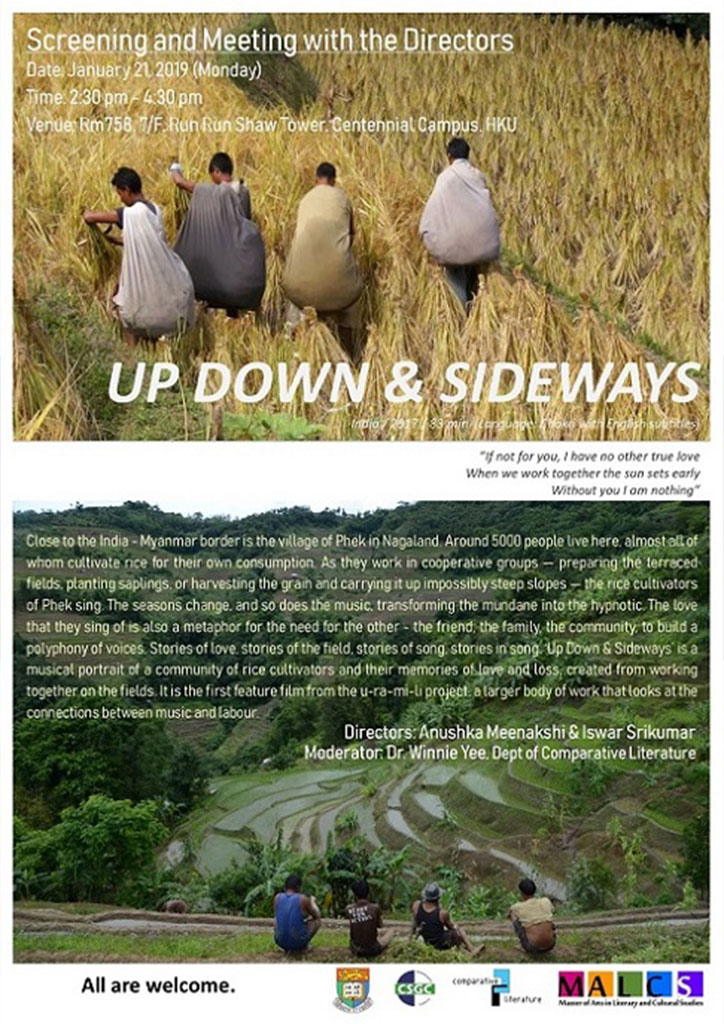
India / 2017 / 83 min (Language: Chokri with English subtitles)
Date: January 21, 2019 (Monday) Time: 2:30 pm – 4:30 pm Venue: Rm758, 7/F, Run Run Shaw Tower, Centennial Campus, HKU
Directors: Anushka Meenakshi & Iswar Srikumar Moderator: Dr. Winnie Yee, Dept of Comparative Literature
“If not for you, I have no other true love
When we work together the sun sets early
Without you I am nothing”
Close to the India – Myanmar border is the village of Phek in Nagaland. Around 5000 people live here, almost all of whom cultivate rice for their own consumption. As they work in cooperative groups — preparing the terraced fields, planting saplings, or harvesting the grain and carrying it up impossibly steep slopes — the rice cultivators of Phek sing. The seasons change, and so does the music, transforming the mundane into the hypnotic. The love that they sing of is also a metaphor for the need for the other – the friend, the family, the community, to build a polyphony of voices. Stories of love, stories of the field, stories of song, stories in song. ‘Up Down & Sideways’ is a musical portrait of a community of rice cultivators and their memories of love and loss, created from working together on the fields. It is the first feature film from the u-ra-mi-li project, a larger body of work that looks at the connections between music and labour.
Directors’ Bio
Anushka Meenakshi has worked as a filmmaker, and a community video trainer. Iswar Srikumar is an actor and a lighting/sound designer for theatre. Iswar and Anushka are both members of Perch, a performance collective in Chennai comprising of artists from various disciplines. In 2011, they started the u-ra-mi-li project (the song of our people), which focuses on stories about music in the everyday, through writing, photograph, performance and film. The u-ra-mi-li project has received support for its work from the India Foundation for the Arts, pad.ma, the Archive and Research Centre for Ethnomusicology and has been selected for the NFDC Film Bazaar WIP Lab (2014) and Docedge Kolkata (2015). We have been commissioned by National Centre for Performing Arts (Mumbai), Puthu Yugam, National Museum of Denmark, Human Factors International and the Pune Biennale 2017 and exhibited work at the National Gallery of Modern Art (Mumbai) and the Bunkier Sztuki Gallery of Contemporary Art, among others.
This award-winning 6-week online course looks at how Hong Kong cinema has become an integral part of global popular culture, and offers uniquely Hong Kong perspectives on the immigrant’s experience, gender and other issues. Week 3 of the course is dedicated to Hong Kong women filmmakers. The pioneering course was developed by internationally recognized film studies scholars Professor Gina Marchetti and Dr. Aaron Han Joon Magnan-Park from the HKU Department of Comparative Literature and Dr. Stacilee Ford from the HKU Department of History and American Studies Program with the creative assistance of HKU TELI (Technology-Enriched Learning Initiative).
Each unit showcases talents, themes, and local-global connections. The cinematic canvas ranges from martial arts and heroic bloodshed films to romantic comedies and migration melodramas. Covering a range of topics, genres, and films, the course features demonstrations of swordplay and action choreography. It also tutors students in the close analysis of film techniques, uncovers the reasons for the worldwide appeal of genres such as the kung fu film, and nurtures a comparative and critical understanding of issues of gender, race, and migration. Interviews with film professionals such as directors Mabel Cheung and Andrew Lau, producer John Sham, film festival director Roger Garcia, and other guests, offer candid insights about the industry.
Faculty of Arts News Letter Winter 2015 Hong Kong Film Course Taps a Global Audience By Faculty of Arts News Letter http://arts.hku.hk/winter2015.pdf
Endorsements
“The second week of the module on HONG KONG CINEMA THROUGH A GLOBAL LENS was a truly exceptional educational experience for me. Like many others of my generation in Film Studies, I also come with a high-brow educational background in Philosophy, literature and cultural history. My credentials in knowing and understanding popular culture are poor – but improving all the time. In the past, I received a major boost in this direction from the work of Savas Arslan on popular Turkish cinema. And now, through the competent and efficient bite-sized commentary on the global phenomenon of Bruce Lee, Aaron Magnan-Park has taken an equally important role in my further education.
So many aspects of this second week were important for me, but I would particularly underscore how pleased I was to see Aaron acknowledging that the very first statue of Bruce Lee has been erected in Mostar, on the territory of former Yugoslavia (now Bosnia and Herzegovina). This prompted me to think of my friend Goran Topalovic who today runs the New York Asian Film Festival at Lincoln Center – but who started off as one of the boys fascinated with the martial art fare coming out of Hong Kong in his early days in Yugoslavia. Aaron, Goran, I think the two of you may have quite a bit to talk about. It would be part of the global conversation that I see Aaron is involved with at the moment, as the photo I found illustrates.”
Professor Dîna Iordanova Department of Film Studies, University of St Andrews 26 Feb 2017
“This is my first ever MOOC session and I’m skeptical about online education. But the lecture and clips overcame my objections and I really enjoyed this session. Like the instructor I was also around in the UK at the time of the Kung Fu craze and remember those Golden Harvest, Shaw Bros releases as well as the first ever King Hu film THE FATE OF LEE KHAN shown in the old Electric Cinema Club in Portobello Road, London. I learned much more about Bruce Lee and his influence from this session and I’m really looking forward to slotting time to watch the rest.” Professor Tony Williams Department of English Southern Illinois University 18 Feb 2017
“ I am so excited about what is probably (one of?) the first MOOC(s) in the teaching of global cinema: The University of Hong Kong’s module on HONG KONG CINEMA TROUGH A GLOBAL LENS, taught by my friend Gina Marchetti with assistance from my friend Aaron Magnan-Park, and others. As my doctoral student Abdulrahman Alghannam put it yesterday — it is ‘the stuff of the future’:) Quite inspirational.
I sat through the introductory videos, on Globalization, yesterday, and was particularly pleased to see how the role that film festivals play is interwoven in the analysis of the processes of globalization in cinema. It is precisely such acknowledgment of festivals that I have always been hoping for will take place when I was first starting to work on film festivals — so I feel rewarded.
Today I am planning to educate myself on Jackie Chan, the world’s most recognizable film star at large. And, I hope to get soon to the moment where Aaron will be teaching on wuxia/martial arts routines — by demonstration, as far as I understand. I have seen the kenpo gear in his office in the Run Run Shaw Tower — on display, but not yet in action…Cannot wait:) ” Professor Dîna Iordanova Department of Film Studies, University of St Andrews 8 Feb 2017
“The brilliant, prolific, and insightful Gina Marchetti has developed a MOOC about Hong Kong Cinema Through a Global Lens. Course is FREE, and you can engage other learners and discussants from around the globe to talk and debate all things cinematic and Hong Kong. NOT TO BE MISSED!” Professor Patricia R. Zimmermann Roy H. Park School of Communications, Ithaca College 10 Jan 2017
This collection offers new approaches to theorizing Asian film in relation to the history, culture, geopolitics and economics of the continent. Bringing together original essays written by established and emerging scholars, this anthology transcends the limitations of national borders to do justice to the diverse ways in which the cinema shapes Asia geographically and imaginatively in the world today. From the revival of the Silk Road as the “belt and road” of a rising China to historical ruminations on the legacy of colonialism across the continent, the authors argue that the category of “Asian cinema” from Turkey to the edges of the Pacific continues to play a vital role in cutting-edge film research. This handbook will serve as an essential guide for committed scholars, students, and all those interested in the past, present, and possible future of Asian cinema in the 21st century.
Get your copy of “The Palgrave Handbook of Asian Cinema” at these links:
Sayings like ‘nothing is accidental’ and ‘things happen for a reason’ makes perfect sense in my case. Looking back at my career – which spans various continents, countries, and institutions – I realise that it has been shaped, to a large extent, by chance encounters that have taken place in the context of social gatherings. There is a certain logic to such developments, though, and it is one that may be worthwhile to extrapolate on.
This workshop will discuss the importance of networking in career development. It will be presented in free form, as discussion, and it will aim to give concrete tips that go beyond the advice to attend the field-specific conference in your fields. It is designed for postgraduate students in the humanities at large.