Gender/Diversity/Democracy: Arts and Humanities Research during the COVID-19 Crisis

View the Zoom recording by clicking here.

Date: Monday, 22 June 2020
Time: 8 PM HK Time (GMT +8)
Speakers: Patricia Zimmermann, Mercedes Vazquez, Ria Sinha

This panel addresses the impact of the current COVID-19 crisis on arts and humanities research with specific emphasis on the challenges facing women and minorities in academic life. Initial research, for example, shows a precipitous drop in journal submissions from women since the lockdown. The crisis also adds fuel to debates surrounding the relevance of the arts and humanities in the twenty-first century. Our panelists cover a range of disciplines and geographic regions to provide a multidimensional conversation and widen our perspective on gender, diversity, and democracy during the pandemic.

SPEAKER AND MODERATOR BIOS
Ria Sinha
Ria Sinha trained as an infectious disease scientist at Imperial College London and Universiteit Leiden, the Netherlands, and is currently senior research fellow in the Centre for the Humanities and Medicine at the University of Hong Kong. Her interdisciplinary research considers the complex and dynamic sociocultural, ecological, technological, and scientific determinants of infectious disease emergence and management.

Mercedes Vazquez
Mercedes Vázquez is a Lecturer and Honorary Assistant Professor at the Faculty of Arts of The University of Hong Kong where she leads the research subcommittee of the Committee on Gender, Equality and Diversity. Her most important recent publications include a monograph on contemporary cinematic representations of class in the cinemas of Latin America—The Question of Class in Contemporary Latin American Cinema (Lanham: Lexington Books, 2018)—, a book chapter comparing diverse figurations of precariousness in Venezuelan cinema, and the Oxford Bibliography on Latin American Cinema (OUP). At HKU, she teaches undergraduate research skills applied to the study of Latin American and European cinemas, Spanish language and Hispanic Cultures, with a focus on gender and sexuality. She has shared her teaching approaches in journals such as Cinegogía and Tinta China, and is currently preparing a webminar comparing pedagogies during COVID in Hong Kong and Mainland China and conducting research on women filmmakers and Latsploitation cinema.

Patricia Zimmermann
Patricia R. Zimmermann is Professor of Screen Studies in the Roy H. Park School School of Communications and codirector of the Finger Lakes Environment Film Festival at Ithaca College, Ithaca, New York. Her most recent book is Documentary Across Platforms: Reverse Engineering Media, Place, and Politics (Bloomington: Indiana University Press, 2019). She is the author of Open Space Collaborative New Media: A Toolkit for Theory and Practice, with Helen De Michiel (London and New York: Routledge Press, 2018); The Flaherty: Fifty Years in the Cause of Independent Cinema, with Scott MacDonald (Bloomington, Indiana: Indiana University Press, 2017); Open Spaces: Openings, Closings, and Thresholds in International Public Media (St. Andrews, Scotland: University of St. Andrews Press, 2016); Thinking through Digital Media: Transnational Environments and Locative Places with Dale Hudson (New York and London: Palgrave MacMillan, 2015); States of Emergency: Documentaries, Wars, Democracies (Minneapolis: University of Minnesota Press, 2000); and Reel Families: A Social History of Amateur Film (Bloomington: Indiana University Press, 1995). She is coeditor with Karen Ishizuka of Mining the Home Movie: Excavations into Historical and Cultural Memories (Berkeley: University of California Press, 2007). Her new book, Flash Flaherty: Tales from a Film Seminar, with Scott MacDonald, will be published in early 2021 by Indiana University Press.

Moderator: Gina Marchetti
Gina Marchetti teaches courses in film, gender and sexuality, critical theory and cultural studies at the University of Hong Kong. She is the author of Romance and the “Yellow Peril”: Race, Sex and Discursive Strategies in Hollywood Fiction (Berkeley: University of California, 1993), From Tian’anmen to Times Square: Transnational China and the Chinese Diaspora on Global Screens (Philadelphia: Temple University Press, 2006), and The Chinese Diaspora on American Screens: Race, Sex, and Cinema (Philadelphia: Temple University Press, 2012), Andrew Lau and Alan Mak’s INFERNAL AFFAIRS—The Trilogy (Hong Kong: Hong Kong University Press, 2007), and Citing China: Politics, Postmodernism, and World Cinema (Hawai’i, 2018), among other publications.

An Ecology of Migrant Life

SPEAKER: Arina Rotaru, Lecturer, Department of Comparative Literature, HKU
MODERATOR: Daniel Elam, Assistant Professor, Department of Comparative Literature, HKU

This presentation discusses the aesthetic potential of artistic experiments emerging in the diaspora and some ways in which they can be tied to an ecology. I position ecology in relation not only to the environment but also to contemporary racialization. The focus of my inquiry lies in the theoretical and performative concept of migritude, which designates migrant strategies of living in the metropolis rather than returning to one’s homeland. Initially applied in a Francophone context, migritude has also taken shape in narrative performance across national borders. I apply the possibility associated with this concept to a discussion of the work of Afro-German author Olumide Popoola, especially through a reading of her account of the refugees of Calais. I then read it in conjunction with a Francophone film on the “jungle camp.”

Outcry and Whisper: An Online Discussion

Outcry and Whisper Trailer

Film Synopsis
Shot over an eight-year period (2007-2015), this documentary film aims to present women’s struggle in the private and public spheres, both in China and Hong Kong. It offers a view into the lives of female factory workers, artists, rights activists, and intellectuals – whom deal with political violence, sexual harassment, online bullying, long-term separation from family, arbitrary treatment by transnational factory, management, and/or poverty in their home villages.

Filmmaker Bibliographies
Huang
Wenhai, Director, Cinematographer, Editor
Huang Wenhai (aka: Wen Hai) studied at the Beijing Film Academy and has since 2001 been active as an independent film director. Among his best known films are Floating Dust (2004), Dream Walking (2006), We (2008), and We the Workers (2017).
*Huang Wehnhai was unable to attend the panel

Trish McAdam, Animation Director
Trish McAdam, Filmmaker and Visual Artist, best Know for Snakes and Ladders (1997), Hoodwinked (1998), No Enemies Liu Xiaobo (2012) and Strangers of Kindness (2015). Member of Aosdana (2017). Irish Film Institute Director in Focus 2019.

Zeng Jinyan, Producer, Co-director, Cinematographer, Performing Artist
Zeng Jinyan, scholar, writer, and documentary filmmaker, a HKU alumna, the 2017 Oak Fellow at Colby College, is the 2020 -2022 Outstanding Chinese and Indian Post-doc Fellow at the University of Haifa.’

“Outcry and Whisper”: A conversation between Jinyan Zeng, Trish McAdam, and Gina Marchetti

How Matter Comes to Matter: New Materialism In Ecology and the Arts

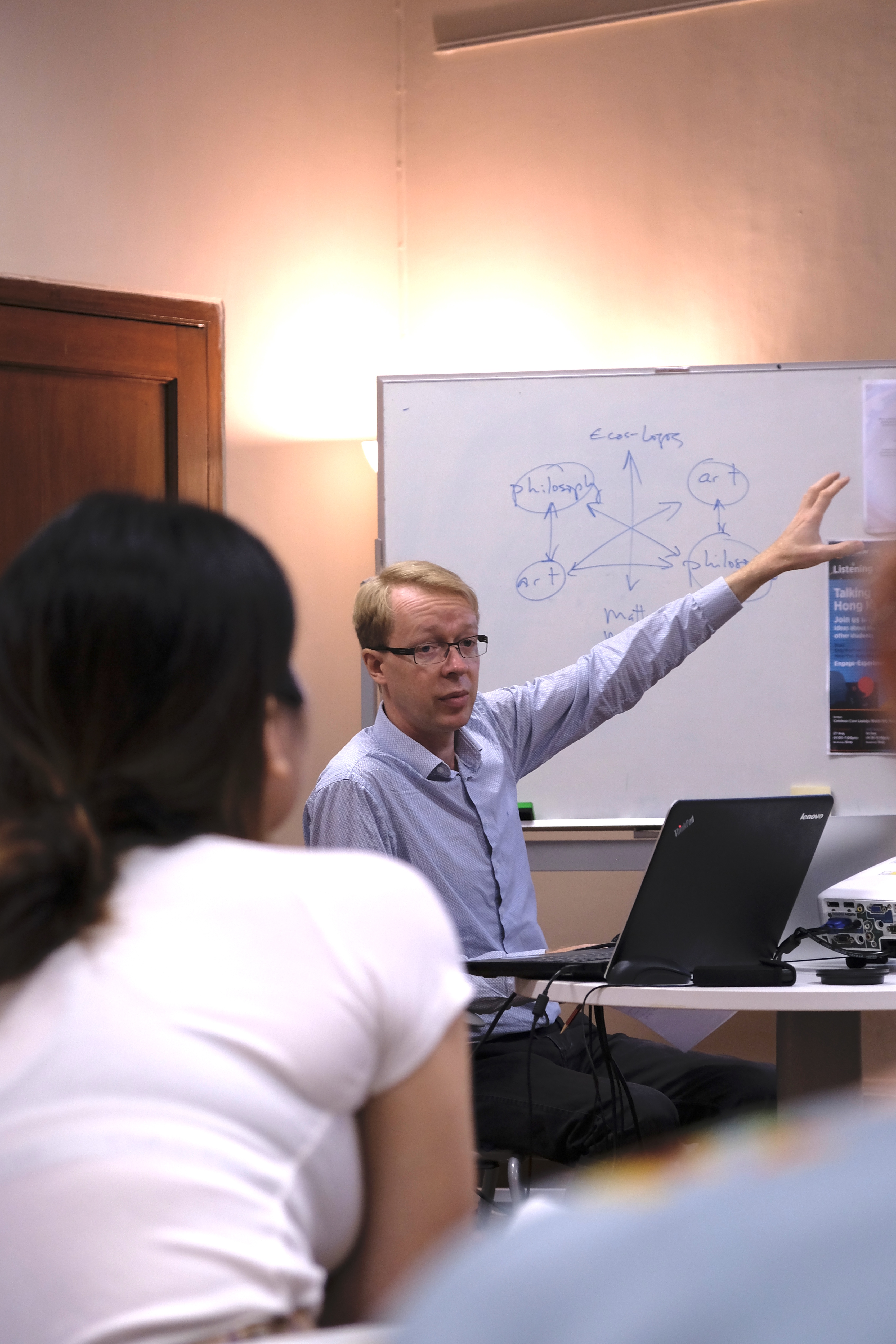
Rick Dolphijn, associate professor at Utrecht University, and Lucas van der Velden, director of Sonic Acts in Amsterdam, gave a talk on new materialist philosophy and sonic art installations at the Common Core Lounge on 16 Oct 2019, hosted by Prof. Gray Kochhar-Lindgren who in his introduction quoted John Dewey’s Art as Experience. The title of the talk, “How Matter Comes to Matter,” was itself from an essay by Karen Barad, an American feminist theorist, and Rick began and ended his presentation by quoting Whitman and Nietzsche, with an eye on the big picture of humans in Nature.

Rethinking humanism and the idea of nature, with “relation” as a starting point to map
how matter matters, Rick discussed a wide range of sources (from Spinoza and Michel
Serres to N. David Mermin and Amitav Ghosh) and fields (from chemistry and quantum
physics to feminist and post-racial theories) for a non-dualistic and non-anthropocentric
materialism that might help people imagine technology, nonhuman life forms, and sense
in new ways, to find blind spots, consider the unthinkable, and envision future humanity
with a “response-ability” for contemporary (ecological and capitalist/humanitarian) crises.

Lucas, the other co-speaker, complemented Rick’s theorization by examples of art that showed “the world otherwise.” Lucas introduced a multidimensional project called Dark Ecology (2014-16), which took place near the Norway-Russia border. It involved artists that dealt with sounds to express their ideas, such as Justin Bennett, who produced an artwork at the Kola Superdeep Borehole; Jana Winderen, who recorded multichannel sounds above and under water; and Raviv Ganchrow, who created a land-art sound installation to investigate infrasound and to probe landscape and long-wave vibrations.

During the Q&A section, among other things, Rick contended that literary realism and mainstream modernism had focused too much on the human to welcome other sounds of the imaginary, and that “indigenous knowledge” might embody not only the past, but also the future. Lucas, however, mentioned a new trend of artists interacting with their natural and social surroundings, including an influx of work about walking, and a new sensitivity in the making, which would bring people together in new alliance. In addition, Lucas hoped that academic writing could be more reader-friendly and open-access.

For more information: www.sonicacts.com, https://www.darkecology.net

Rick Dolphijn and Iris van der Tuin, New Materialism: Interviews & Cartographies (2013)
http://openhumanitiespress.org/books/download/Dolphijn-van-der-Tuin_2013_New-Materialism.pdf

The People I’ve Slept With: A Film Screening and Q&A

Speaker:  Quentin Lee
Moderator: Dr Alvin Wong, Department of Comparative Literature, HKU

“The People I’ve Slept With” (2009) is a sexy romantic comedy about a young promiscuous woman who must find her baby daddy. The movie features an all star Asian American cast such as Karin Anna Cheung (Better Luck Tomorrow), Wilson Cruz (My So-called Life), Archie Kao (Zhou Xun’s ex-husband, CSI), Lynn Chen (Saving Face), Randall Park (Fresh Off the Boat) and the legendary James Shigeta (Flower Drum Sung) in his last feature.

About the director:
“The People I’ve Slept With” is Los Angeles based Hong Kong born filmmaker Quentin Lee’s fifth feature that initially played high profile film festivals such as Hawaii, Golden Horse and Sao Paolo before being released theatrically in North America and on Netflix. “The People I’ve Slept With” Is now streaming worldwide via Amazon and Tubi.TV.

Date: Wednesday 22 May 2019

Time: 4-6 PM

Venue: 2.42, 2/F, Sir Run Run Shaw Tower, Centennial Campus, HKU

All are welcome.

For general enquiries, please contact Christine Vicera at viceracn@hku.hk