This collection offers new approaches to theorizing Asian film in relation to the history, culture, geopolitics and economics of the continent. Bringing together original essays written by established and emerging scholars, this anthology transcends the limitations of national borders to do justice to the diverse ways in which the cinema shapes Asia geographically and imaginatively in the world today. This handbook will serve as an essential guide for committed scholars, students and all those interested in the past, present and possible future of Asian cinema in the 21st century.
The event will feature a series of short presentations given by contributors of the anthology including Aaron Magnan-Park, Gina Marchetti, Winnie Yee, Staci Ford, See Kam Tan and Bruno Lovric.
Weaving together the stories and interactions of five activists (Joshua Wong, Denise Ho, Wong Yeung Tat, Ed Lau and Derek Lam) and their friends with astonishing fluidity as they come to terms with life in a post-Umbrella Movement Hong Kong and the realisation that life is the sum of all their choices. Director Matthew Torne (Lessons in Dissent [2014], Joshua: Teenager vs Superpower [2017]) serves up five slices of Twenty-First Century Hong Kong life in this ambitious mosaic of a film. A Q&A with Director, Matthew Torne, and his Associate Producer, Rex Lee will be held after the film screening.
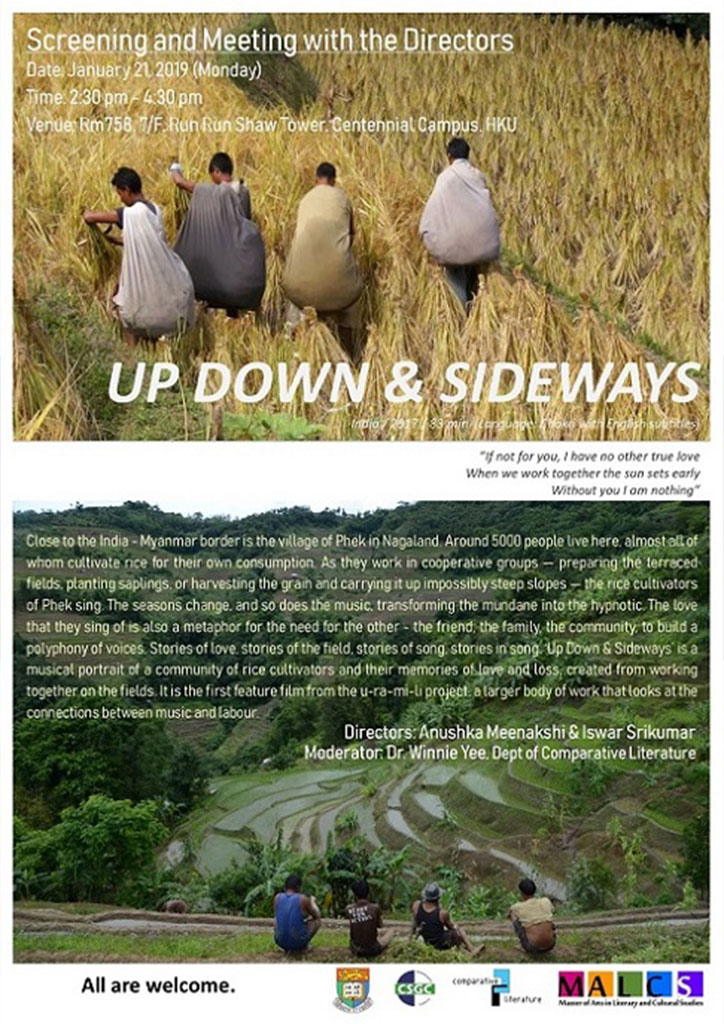
India / 2017 / 83 min (Language: Chokri with English subtitles)
Date: January 21, 2019 (Monday) Time: 2:30 pm – 4:30 pm Venue: Rm758, 7/F, Run Run Shaw Tower, Centennial Campus, HKU
Directors: Anushka Meenakshi & Iswar Srikumar Moderator: Dr. Winnie Yee, Dept of Comparative Literature
“If not for you, I have no other true love
When we work together the sun sets early
Without you I am nothing”
Close to the India – Myanmar border is the village of Phek in Nagaland. Around 5000 people live here, almost all of whom cultivate rice for their own consumption. As they work in cooperative groups — preparing the terraced fields, planting saplings, or harvesting the grain and carrying it up impossibly steep slopes — the rice cultivators of Phek sing. The seasons change, and so does the music, transforming the mundane into the hypnotic. The love that they sing of is also a metaphor for the need for the other – the friend, the family, the community, to build a polyphony of voices. Stories of love, stories of the field, stories of song, stories in song. ‘Up Down & Sideways’ is a musical portrait of a community of rice cultivators and their memories of love and loss, created from working together on the fields. It is the first feature film from the u-ra-mi-li project, a larger body of work that looks at the connections between music and labour.
Directors’ Bio
Anushka Meenakshi has worked as a filmmaker, and a community video trainer. Iswar Srikumar is an actor and a lighting/sound designer for theatre. Iswar and Anushka are both members of Perch, a performance collective in Chennai comprising of artists from various disciplines. In 2011, they started the u-ra-mi-li project (the song of our people), which focuses on stories about music in the everyday, through writing, photograph, performance and film. The u-ra-mi-li project has received support for its work from the India Foundation for the Arts, pad.ma, the Archive and Research Centre for Ethnomusicology and has been selected for the NFDC Film Bazaar WIP Lab (2014) and Docedge Kolkata (2015). We have been commissioned by National Centre for Performing Arts (Mumbai), Puthu Yugam, National Museum of Denmark, Human Factors International and the Pune Biennale 2017 and exhibited work at the National Gallery of Modern Art (Mumbai) and the Bunkier Sztuki Gallery of Contemporary Art, among others.
Sayings like ‘nothing is accidental’ and ‘things happen for a reason’ makes perfect sense in my case. Looking back at my career – which spans various continents, countries, and institutions – I realise that it has been shaped, to a large extent, by chance encounters that have taken place in the context of social gatherings. There is a certain logic to such developments, though, and it is one that may be worthwhile to extrapolate on.
This workshop will discuss the importance of networking in career development. It will be presented in free form, as discussion, and it will aim to give concrete tips that go beyond the advice to attend the field-specific conference in your fields. It is designed for postgraduate students in the humanities at large.
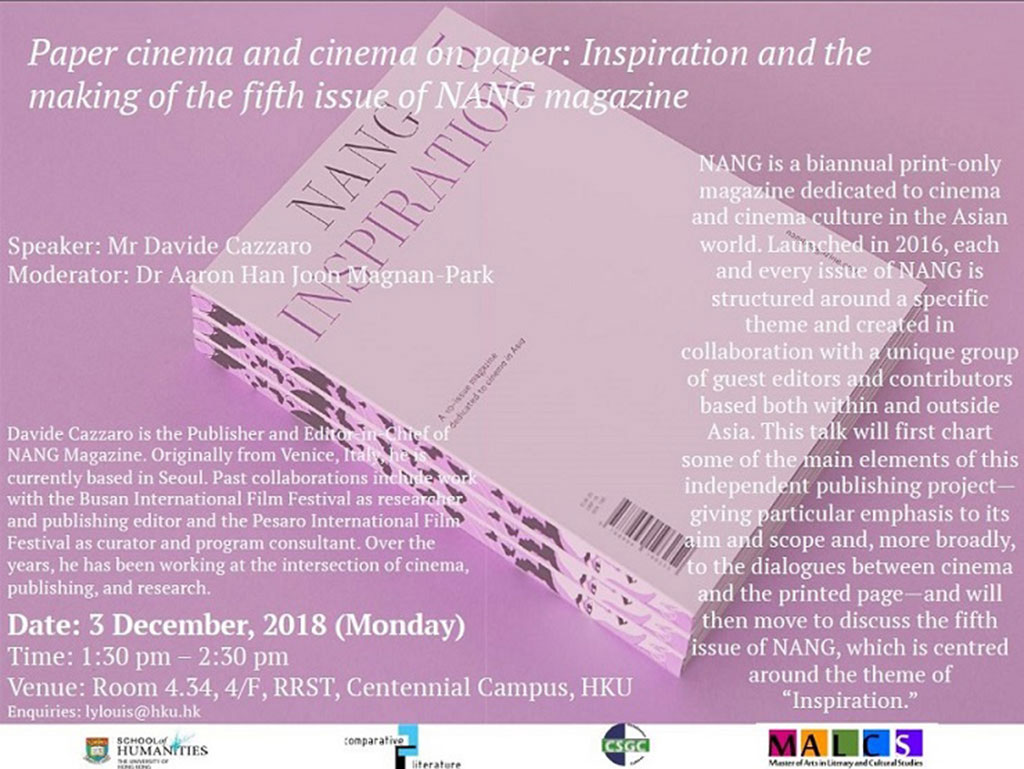
NANG is a biannual print-only magazine dedicated to cinema and cinema culture in the Asian world. Launched in 2016, each and every issue of NANG is structured around a specific theme and created in collaboration with a unique group of guest editors and contributors based both within and outside Asia. This talk will first chart some of the main elements of this independent publishing project—giving particular emphasis to its aim and scope and, more broadly, to the dialogues between cinema and the printed page—and will then move to discuss the fifth issue of NANG, which is centred around the theme of “Inspiration.”
Speaker: Mr Davide Cazzaro
Moderator: Dr Aaron Han Joon Magnan-Park
Speaker Bio:
Davide Cazzaro is the Publisher and Editor-in-Chief of NANG Magazine. Originally from Venice, Italy, he is currently based in Seoul. Past collaborations include work with the Busan International Film Festival as researcher and publishing editor and the Pesaro International Film Festival as curator and program consultant. Over the years, he has been working at the intersection of cinema, publishing, and research.
Date: 3 December 2018 Time: 1:30 pm – 2:30 pm Venue: Room 4.34, 4/F, Run Run Shaw Tower, Centennial Campus, HKU
The Women’s Summit on Film was held on the 23rd November 2018. Dedicated to women involved in teaching, research, and administration related to film production and cinema studies in Hong Kong higher education. The event was sponsored by the Centre for the Study of Globalization and Cultures, and involved participants from higher education institutions as well as filmmakers, film critics and film festival directors.
Given the recent initiatives at the University of Hong Kong such as HeForShe involving gender equality and diversity, the Summit intended to initiate an expanded conversation about the current state of women in film production, research, and education in Hong Kong.
Conversations revolved around topics such as:
Challenges faced by women teaching film in Hong Kong
Academic advancement
Researching women in film in the university
Funding for film research and filmmaking in the Hong Kong university system
Film festivals, women’s festivals and the Hong Kong university
#MeToo in film school
Sexism and bias in academia
Queer/feminist teaching, research, and advocacy
Hong Kong filmmakers in a global context
The CSGC is in the process of planning a follow-up #HeforShe summit to involve male academic staff in the conversation which is to be held in the Spring Semester of 2019. For more updates, follow our page.
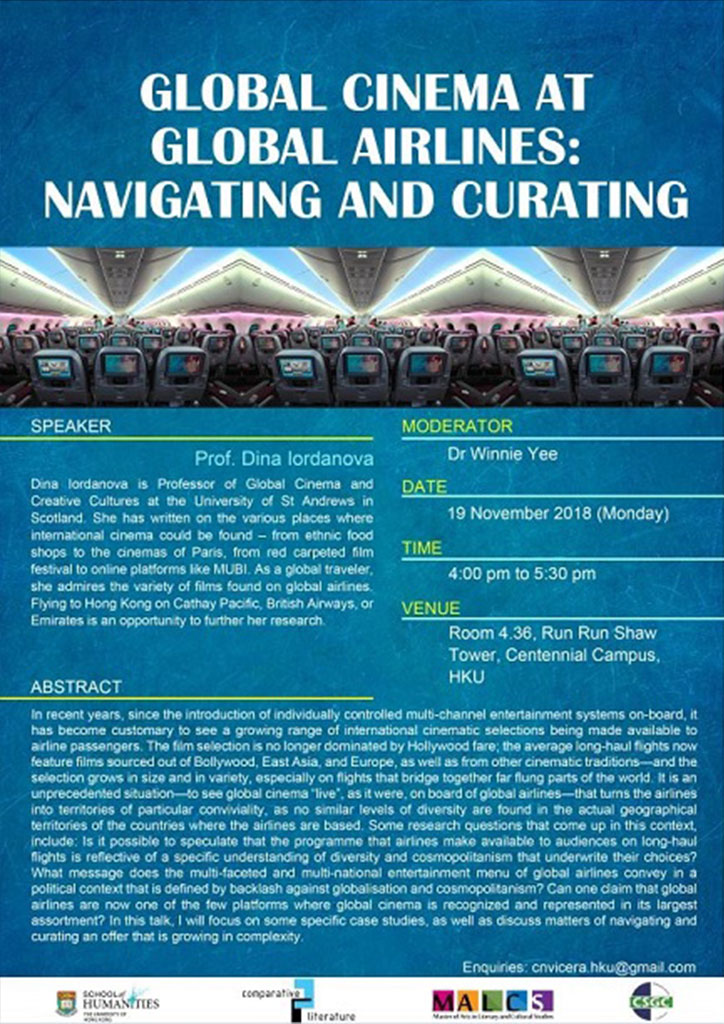
In recent years, since the introduction of individually controlled multi-channel entertainment systems on-board, it has become customary to see a growing range of international cinematic selections being made available to airline passengers. The film selection is no longer dominated by Hollywood fare; the average long-haul flights now feature films sourced out of Bollywood, East Asia, and Europe, as well as from other cinematic traditions—and the selection grows in size and in variety, especially on flights that bridge together far flung parts of the world. It is an unprecedented situation—to see global cinema “live”, as it were, on board of global airlines—that turns the airlines into territories of particular conviviality, as no similar levels of diversity are found in the actual geographical territories of the countries where the airlines are based. Some research questions that come up in this context, include: Is it possible to speculate that the programme that airlines make available to audiences on long-haul flights is reflective of a specific understanding of diversity and cosmopolitanism that underwrite their choices? What message does the multi-faceted and multi-national entertainment menu of global airlines convey in a political context that is defined by backlash against globalisation and cosmopolitanism? Can one claim that global airlines are now one of the few platforms where global cinema is recognized and represented in its largest assortment? In this talk, I will focus on some specific case studies, as well as discuss matters of navigating and curating an offer that is growing in complexity.
Speaker: Prof. Dina Iordanova Moderator: Dr Winnie Yee (MALCS Programme Coordinator)
Speaker Bio:
Dina Iordanova is Professor of Global Cinema and Creative Cultures at the University of St Andrews in Scotland. She has written on the various places where international cinema could be found – from ethnic food shops to the cinemas of Paris, from red carpeted film festival to online platforms like MUBI. As a global traveler, she admires the variety of films found on global airlines. Flying to Hong Kong on Cathay Pacific, British Airways, or Emirates is an opportunity to further her research.
Date: 19 November 2018 (Monday) Time: 4:00 pm – 5:30 pm Venue: Room 4.36, Run Run Shaw Tower, Centennial Campus
Action films have remained as one of the most important and influential genres. Beyond action films, action is an element widely adopted by other genres such as sci-fi, comedy and crime, etc. In different countries and regions, action films have their respective origins and evolved in the interactions with each other. The transnational and cross-cultural integrations and integrations of cross-genres and cross-subgenres have made action films a hybrid genre, in other words, a Super-genre. This classification helps us recognize the core of this super-genre (or the shared cores of these genres). Self-evidently, the super-genre relies on actions much more than words. From an iconographic view, it centers on the images of human body. Action films always present conflicts which are between bodies or between bodies and space. And these conflicts are presented as visible violent activities of bodies, in the forms of fists fight, swords dance, gun fire, chasing, explosions or any other combats with tools.
This workshop addresses questions postgraduate, post-doctorate, and junior researchers in the arts and humanities may have concerning the publication of their scholarship in peer-reviewed, professional, trade, popular, and other venues. Professor Iordanova will introduce the various publication outlets open to academics and the relative impact these have within and outside specific disciplines. She explores traditional outlets as well as other means of disseminating research including blogs, online newsletters, video essays, and other less orthodox avenues. Participants are invited to bring their own publication problems and queries for discussion within the context of an informal conversation on “publish or perish” in the digital age.