How is nostalgia relevant to New Chinese Cinema? Its avowed forward-looking politics notwithstanding, New Chinese Cinema in the 1980s surprisingly sustains nostalgic for the foregoing age. The talk will introduce the conceptualisation of nostalgia in both China and the West before drawing a detailed picture of the nostalgic cinema. King of the Children (Haizi Wang, Chen Kaige, 1987) will be read as an example, in which sundry voices of the past bespeak a reflective and non-political nostalgia. The talk also welcomes inspirations on the relation between nostalgia and Hong Kong New Wave.
Speaker: Mr. September Liu Moderator: Prof. Dina Iordanova
Speaker Bio: September Liu is a PhD candidate in the Department of Film Studies, University of St.Andrews. His current research focuses on nostalgia and Chinese New Waves. He has received an MPhil in Asian and Middle Eastern Studies at Downing College, University of Cambridge, and two BAs in English and Chinese Literature at Peking University.
Date:6 November 2018 (Tue) Time: 16:00 – 17:30 Venue:Room 436, 4/F, Run Run Shaw Tower, Centennial Campus, HKU
What is to be done after André Bazin (1918–59) and Gilles Deleuze (1925–95)? With the emergence of the digital image in the 1990s and the proliferation of social media platforms afterwards, a renewed understanding of the cinema as a medium that has fundamentally redefined humanity and its relationship with techne (technics) has been debated. In this discussion, Buddhism may offer us new insights into what cinema is and what it can be.
In my presentation, I use Buddhist philosophy to re-examine cinema ontology. I first conduct a close analysis of Bazin’s own text by contextualising it both within European philosophy and in conversation with the Buddhist understanding interdependent relationships. Under such a renewed scrutiny, I argue, reality is perhaps not the ontological ground of the photographic image. Rather, an alaya (storehouse)-consciousness gives rise to the photograph as a technical milieu, which performs reality as a form without any existential value. In this sense, cinema ontology can be understood anew a crisis of the image generated from a deeper perturbation about human existence.
Speaker: Dr Victor Fan
Victor Fan is Senior Lecturer at Film Studies, King’s College London and Film Consultant of the Chinese Visual Festival. His articles appeared in journals including Camera Obscura, Journal of Chinese Cinemas, Screen and Film History: An International Journal. His book Cinema Approaching Reality: Locating Chinese Film Theory was published in 2015 by the University of Minnesota Press.
Moderator: Dr Alvin Wong
Date: 16 October 2018 (Tue) Time: 16:00-17:30 Venue: Room 436, 4/F, Run Run Shaw Tower, Centennial Campus, HKU
Speaker: Professor Dina Iordanova FRSA Professor of Global Cinema and Creative Cultures Director, Institute for Global Cinema and Creative Cultures (IGCCC) Publisher, St Andrews Film Studies University of St Andrews, Scotland
Date: 11 December 2017 (Monday) Time: 5:00pm-6:30pm Venue: Rm. 4.36, Run Run Shaw Tower, Centennial Campus, HKU
Moderator: Professor Nicole Huang (Chairperson , Department of Comparative Literature, HKU)
Abstract There is no other city for cinema like Paris. However, the city’s reputation related to cinema links more to events from the past (such as the first cinema projection in 1895 or the nouvelle vague of the 1060s) rather than to present-day realities. The unique cinematic culture of Paris is best revealed in three spheres. First, Paris is the city which exhibits by far the largest variety of international films and enjoys a cinematic culture that is by far superior to every other city. Then, Paris is home to the widest multicultural group of international film talent, a place where global film professionals are clustered more than any other city. And last, Paris is the city where a great array of global cinema is effectively conceived and produced. Yet, there is little international recognition of these achievements. In this talk, I will aim to examine why the importance of Paris as hub for global cinema remains obscured.
Bio Dina Iordanova is a professor at University of St Andrews in Scotland and is currently a Visiting Research Professor with the Department of Comparative Literature at HKU. A native of Bulgaria who has also worked in the United States and conducted research across Europe and Asia, Dina is the founder of Film Studies at St Andrews. She has published extensively on matters of global cinema and film cultures. Her most recent book is CINEMAS OF PARIS, with Jean-Michel Frodon.
All are welcome.
Co-organized by: Center for the Study of Globalization and Cultures (CSGC) Department of Comparative Literature, HKU
Date: Wednesday 29 November 2017 Time: 6:30 p.m. Venue: Room 4.36, Run Run Shaw Tower, Centennial Campus, the University of Hong Kong
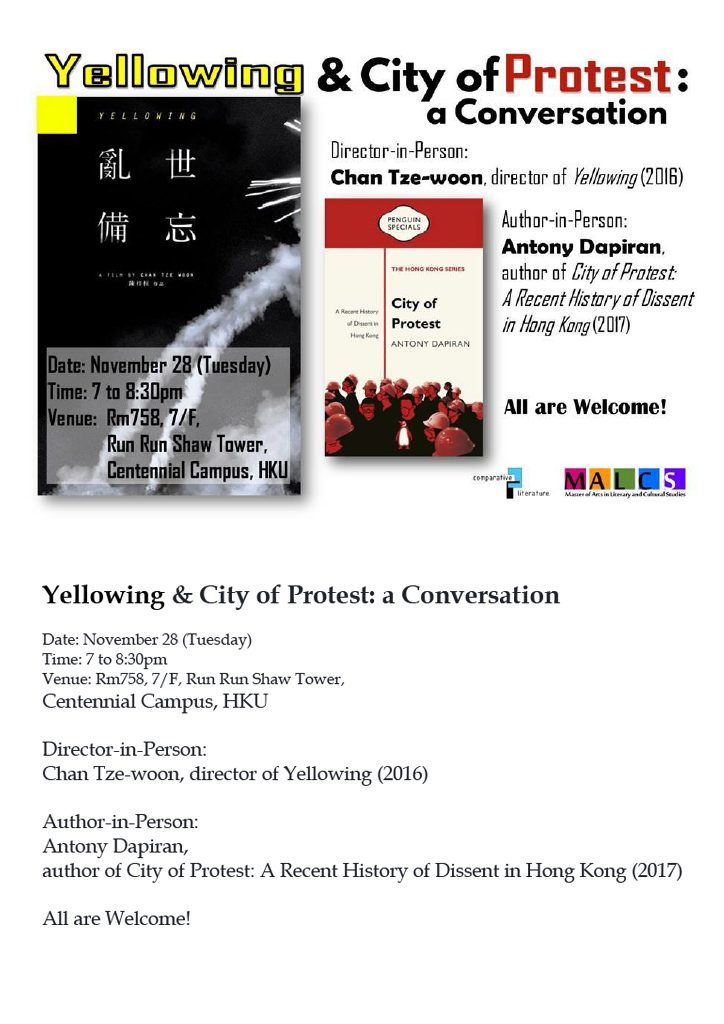
Speakers: Evans Chan, Mei Fong and Timothy O’Leary Moderator: Ilaria Maria Sala
Panelists: Evans Chan ‘One of the most singularly innovative and diverse figures in the Chinese cultural world’ (Michael Berry, Speaking in Images), Evans Chan is the director of Raise the Umbrellas (2016), which has been hailed as ‘the most comprehensive documentary’ about Hong Kong’s 2014 democratic movement. Chan’s latest documentary is Death in Montmartre.
Mei Fong Mei Fong is a Pulitzer-prize winning former journalist, New America fellow and listed as one of Foreign Policy’s Top 50 influencers on US-China relations. She is the author of One Child: The Story of China’s Most Radical Experiment (2016). As a form of protest against China’s growing censorship, she released a free digital download of her book in simplified Chinese.
Timothy O’Leary Timothy O’Leary has lived in Hong Kong since 2001. He is Professor of Philosophy at the University of Hong Kong, where he is an elected member of HKU Council. He has been an active defender of academic freedom at HKU for a number of years. He has published extensively in the fields of ethics, aesthetics, the critical powers of fiction, and the work of the French philosopher Michel Foucault. He is co-General Editor of the book series New Critical Humanities at Rowman & Littlefield International. Timothy is PEN Hong Kong’s Secretary.
Moderator: Ilaria Maria Sala Ilaria Maria Sala is an-award winning writer and journalist based in Hong Kong. She has been living in Asia since 1988—first in Beijing, then Tokyo and Hong Kong, with long detours in Shanghai and Kathmandu. Her byline has appeared in Le Monde, the New York Times, the Guardian, ArtNews, El Periódico and La Stampa, among others. Her latest book is Letters from China (in Italian). Ilaria is a founding member of PEN Hong Kong.
All are welcome
Co-organized by: Pen Hong Kong Center for the Study of Globalization and Cultures (CSGC) Department of Comparative Literature, HKU
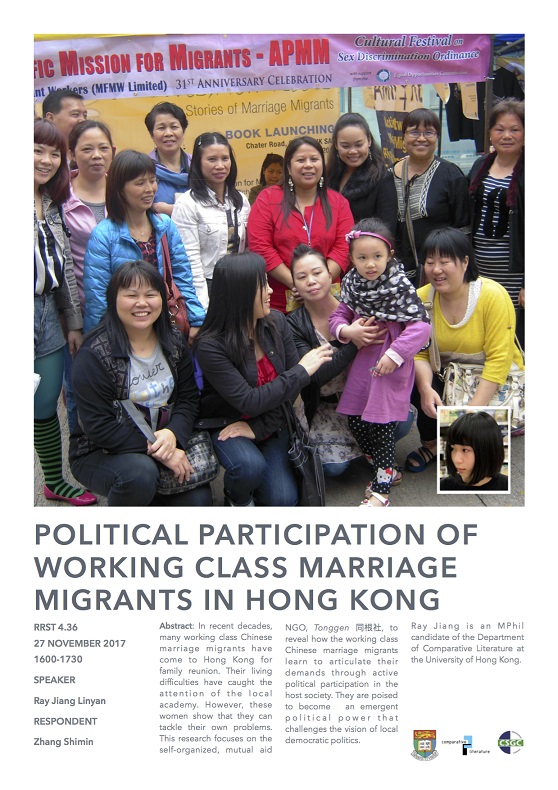
DATE: 27 NOVEMBER 2017 TIME: 1600-1730 VENUE: RRST 4.36 SPEAKER: Ray Jiang Linyan RESPONDENT: Zhang Shimin
Abstract: In recent decades, many working class Chinese marriage migrants have come to Hong Kong for family reunion. Their living difficulties have caught the attention of the local academy. However, these women show that they can tackle their own problems. This research focuses on the self-organized, mutual aid NGO, Tonggen ???, to reveal how the working class Chinese marriage migrants learn to articulate their demands through active political participation in the host society. They are poised to become an emergent political power that challenges the vision of local democratic politics.
Ray Jiang is an MPhil candidate of the Department of Comparative Literature at the University of Hong Kong.
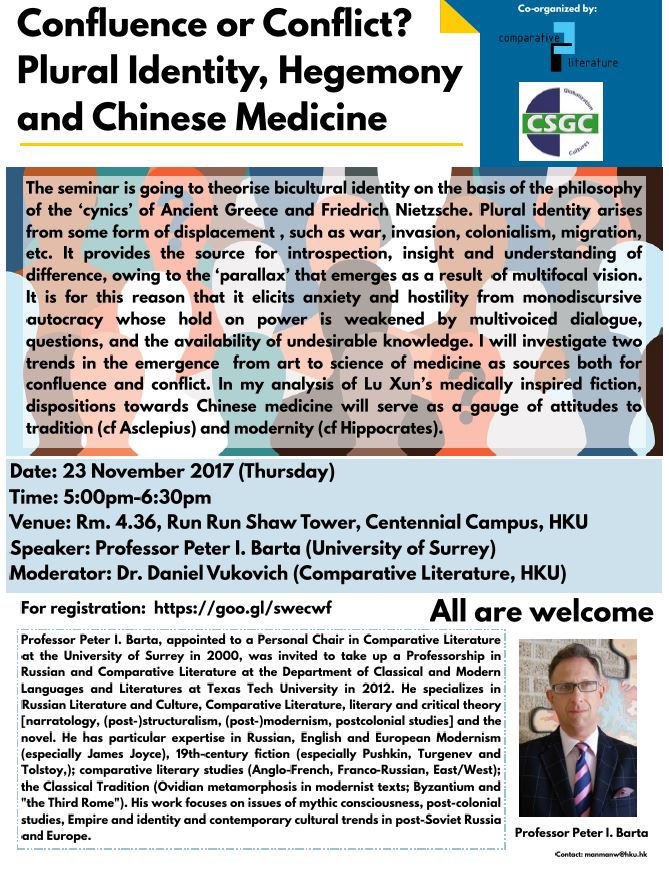
Date: 23 November 2017 (Thursday) Time: 5:00pm-6:30pm Venue: Rm. 4.36, Run Run Shaw Tower, Centennial Campus, HKU
Speaker: Professor Peter I. Barta (University of Surrey; Texas Tech University ) Moderator: Dr. Daniel Vukovich (Comparative Literature, HKU)
The seminar is going to theorise bicultural identity on the basis of the philosophy of the ‘cynics’ of Ancient Greece and Friedrich Nietzsche. Plural identity arises from some form of displacement , such as war, invasion, colonialism, migration, etc. It provides the source for introspection, insight and understanding of difference, owing to the ‘parallax’ that emerges as a result of multifocal vision. It is for this reason that it elicits anxiety and hostility from monodiscursive autocracy whose hold on power is weakened by multivoiced dialogue, questions, and the availability of undesirable knowledge. I will investigate two trends in the emergence from art to science of medicine as sources both for confluence and conflict. In my analysis of Lu Xun’s medically inspired fiction, dispositions towards Chinese medicine will serve as a gauge of attitudes to tradition (cf Asclepius) and modernity (cf Hippocrates).
Professor Peter I. Barta, appointed to a Personal Chair in Comparative Literature at the University of Surrey in 2000, was invited to take up a Professorship in Russian and Comparative Literature at the Department of Classical and Modern Languages and Literatures at Texas Tech University in 2012. He specializes in Russian Literature and Culture, Comparative Literature, literary and critical theory [narratology, (post-)structuralism, (post-)modernism, postcolonial studies] and the novel. He has particular expertise in Russian, English and European Modernism (especially James Joyce), 19th-century fiction (especially Pushkin, Turgenev and Tolstoy,); comparative literary studies (Anglo-French, Franco-Russian, East/West); the Classical Tradition (Ovidian metamorphosis in modernist texts; Byzantium and “the Third Rome”). His work focuses on issues of mythic consciousness, post-colonial studies, Empire and identity and contemporary cultural trends in post-Soviet Russia and Europe.
All are welcome
Co-organized by: Center for the Study of Globalization and Cultures (CSGC) Department of Comparative Literature, HKU
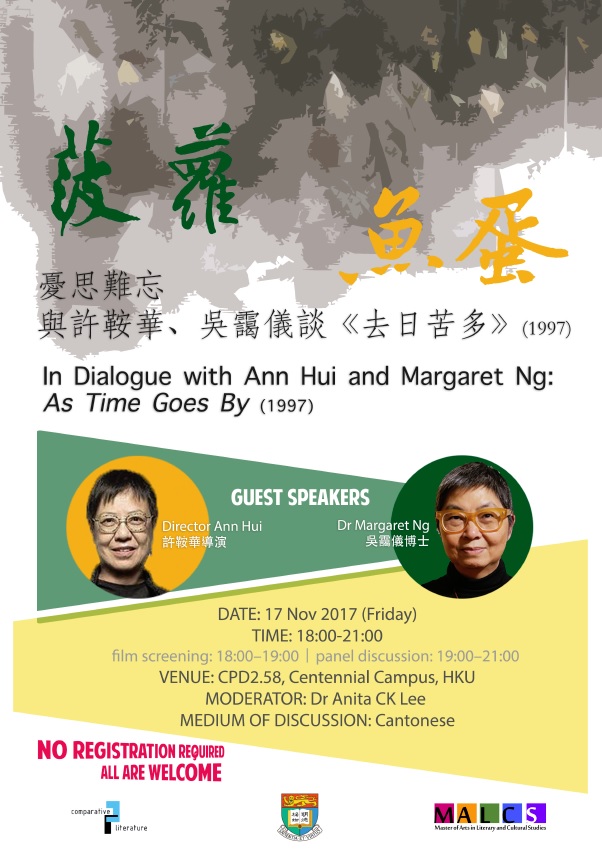
Guest Speakers: Director Ann Hui and Dr. Margaret Ng Moderator: Dr. Anita C.K. Lee
Event: Film screening and panel discussion Date: 17 November 2017 (Friday) Time: 18:00-21:00 (Film Screening: 18:00 – 19:00, Panel Discussion: 19:00 – 21:00) Venue: CPD2.58, Centennial Campus, The University of Hong Kong
The MALCS Programme of the Department of Comparative Literature is proud to present an event on 17 Nov 2017 (Friday) for a film screening and panel discussion with director Ann Hui (許鞍華) and Dr Margaret Ng (吳靄儀). The panel discussion is about the hour-long documentary by Ann Hui in 1997, As Time Goes By (《去日苦多》). In the documentary, the director invites her university friends to reminisce about their college days and, in the process, engage in a discussion about education and local history in the colonial days. When 1997 marks the year of the Handover of sovereignty of Hong Kong, the film inevitably examines Hong Kong people’s sense of identity and their vision for the years ahead into the new future under China. Twenty years have passed since 1997, it is an opportune time to explore the differences between the “new future” they envisioned two decades ago and the impending reality that Hong Kong people are experiencing in the recent years.
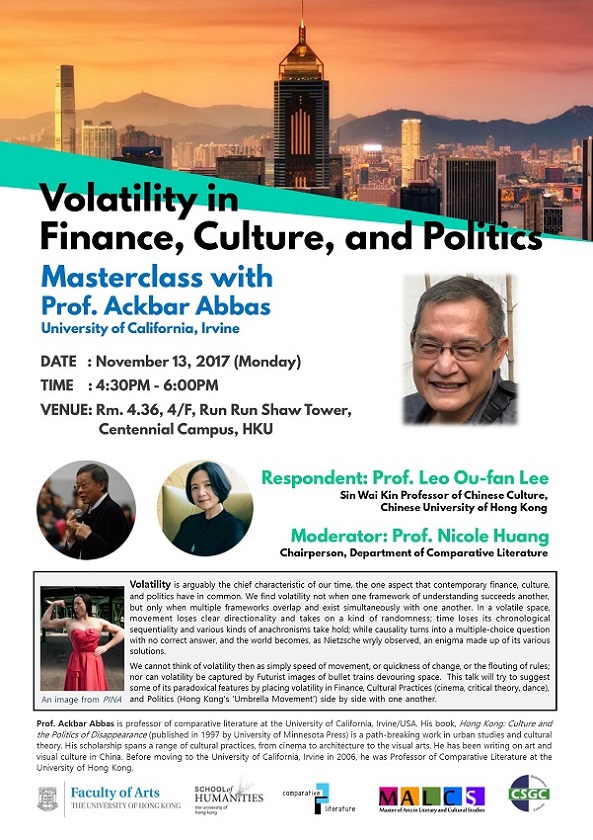
Masterclass with Prof. Ackbar Abbas (University of California, Irvine)
Respondent: Prof. Leo Ou-fan Lee (Sin Wai Kin Professor of Chinese Culture, Chinese University of Hong Kong)
Moderator: Prof. Nicole Huang (Chairperson, Department of Comparative Literature)
DATE : November 13, 2017 (Monday) TIME : 4:30PM – 6:00PM VENUE: Rm. 4.36, 4/F, Run Run Shaw Tower, Centennial Campus, HKU
Abstract: Volatility is arguably the chief characteristic of our time, the one aspect that contemporary finance, culture, and politics have in common. We find volatility not when one framework of understanding succeeds another, but only when multiple frameworks overlap and exist simultaneously with one another. In a volatile space, movement loses clear directionality and takes on a kind of randomness; time loses its chronological sequentiality and various kinds of anachronisms take hold; while causality turns into a multiple-choice question with no correct answer, and the world becomes, as Nietzsche wryly observed, an enigma made up of its various solutions.
We cannot think of volatility then as simply speed of movement, or quickness of change, or the flouting of rules; nor can volatility be captured by Futurist images of bullet trains devouring space. This talk will try to suggest some of its paradoxical features by placing volatility in Finance, Cultural Practices (cinema, critical theory, dance), and Politics (Hong Kong’s ‘Umbrella Movement’) side by side with one another
Biography: Prof. Ackbar Abbas is professor of comparativeliterature at the University of California, Irvine/USA. His book, Hong Kong: Culture and the Politics of Disappearance (published in 1997 by University of Minnesota Press) is a path-breaking work in urban studies and cultural theory. His scholarship spans a range of cultural practices, from cinema to architecture to the visual arts. He has been writing on art and visual culture in China. Before moving to the University of California, Irvine in 2006, he was Professor of ComparativeLiterature at the University of Hong Kong.
Organizers: Faculty of Arts, School of Humanities, Department of Comparative Literature, M.A. in Literary and Cultural Studies (MALCS) and Center for the Studyof Globalization and Cultures (CSGC)
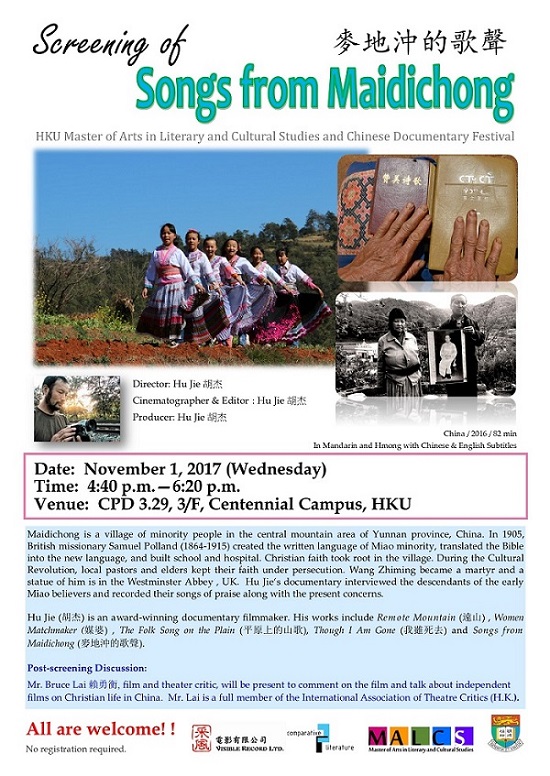
Maidichong is a village of minority people in the central mountain area of Yunnan province, China. In 1905, British missionary Samuel Polland (1864-1915) created the written language of Miao minority, translated the Bible into the new language, and built school and hospital. Christian faith took root in the village. During the Cultural Revolution, local pastors and elders kept their faith under persecution. Wang Zhiming became a martyr and a statue of him is in the Westminster Abbey , UK. Hu Jie’s documentary interviewed the descendants of the early Miao believers and recorded their songs of praise along with the present concerns.
Hu Jie (胡杰) is an award-winning documentary filmmaker. His works include Remote Mountain (遠山) , Women Matchmaker (媒婆) , The Folk Song on the Plain (平原上的山歌), Though I Am Gone (我雖死去) and Songs from Maidichong (麥地沖的歌聲).
Post-screening Discussion: Mr. Bruce Lai 賴勇衡, film and theater critic will be present to comment on the film and talk about independent films on Christian life in China. Mr. Lai is a full member of the International Association of Theatre Critics (Hong Kong).