1. EVENT INFO
University of Hong Kong
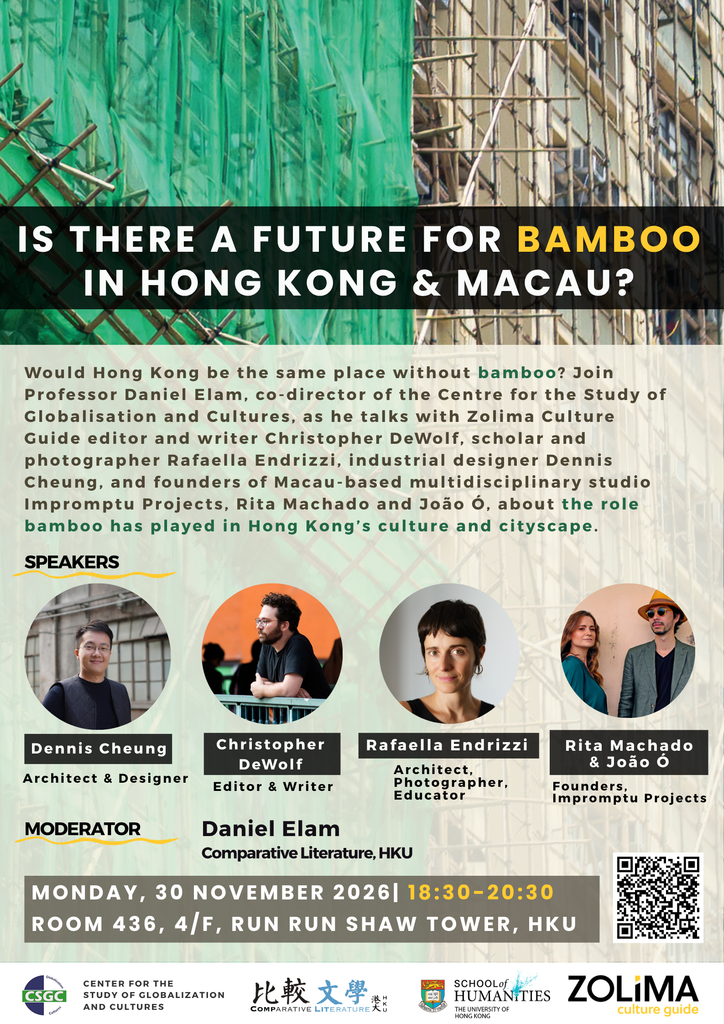
Title: What Bamboo Means to Hong Kong and Macau
Date: Monday, 30 November 2026
Time: 18:30-20:30
Venue: Room 436, 4/F, Run Run Shaw Tower, The University of Hong Kong
Speakers: Christopher Dewolf, Dennis Cheung, Rafaella Endrizzi, Rita Machado & João Ó (Impromptu Projects)
Moderator: Daniel Elam, Comparative Literature, HKU
Booking link: https://hkuems1.hku.hk/hkuems/ec_hdetail.aspx?guest=Y&ueid=110327
2. EVENT INTRO
Would Hong Kong be the same place without bamboo? Join Professor Daniel Elam, co-director of Center for the Study of Globalization and Cultures, as he talks with Zolima Culture Guide editor and writer Christopher Dewolf, scholar and photographer Raffaella Endrizzi, industrial designer Dennis Cheung and founders of multi-disciplinary studio Impromptu Projects Rita Machado & João Ó about the role bamboo has played in Hong Kong’s culture and cityscape.
3. BOOK DESCRIPTION
Zolima Culture Guide. Vol.3
The Bamboo Metropolis – The City Made By Bamboo
WHY WE CREATED THE BAMBOO METROPOLIS
Hong Kong has a habit of overlooking what has always been there.
Bamboo is everywhere. It climbs skyscrapers, shelters opera singers, steams dim sum, becomes lion heads and lanterns, frames rituals and inspires artists and architects.
It is one of Hong Kong’s defining materials — and one of its least understood.
Today, bamboo scaffolding is facing increasing pressure. Traditional crafts are losing apprentices. Knowledge that has shaped Hong Kong for generations is becoming more fragile. Yet this isn’t a story about disappearance or nostalgia.
It is a book about scaffolders and chefs, theatres and skyscrapers, artists and artisans, rituals and reinvention. Above all, it is a book about the material that has helped Hong Kong become itself.
At the very moment many people assume bamboo belongs to the past, it is being rediscovered in unexpected ways. Architects are testing it as a sustainable building material. Artists are using it to explore memory, identity and place. Designers are uncovering new possibilities in one of Hong Kong’s oldest materials. Younger Hongkongers are beginning to see what has always been in front of them.
That is why we created The Bamboo Metropolis: to look closely at bamboo before it is reduced to nostalgia — and to ask how it can continue to grow.
The Bamboo Metropolis is not a lament. It’s an argument for attention. It explains how bamboo works, why it matters and what could be lost if Hong Kong allows this knowledge to fade.
The Bamboo Metropolis spans more than 330 pages, richly illustrated with original photography and specially commissioned illustrations. Combining long-form storytelling with visual essays, the book offers a fresh perspective on a material that most of us see every day — but rarely stop to understand.
4. SPEAKERS BIOGRAPHIES
Christopher DeWolf
Christopher DeWolf has been writing about Hong Kong for more than 20 years, earning a reputation as one of the city’s leading journalists on architecture, design, history and culture. The author of Borrowed Spaces: Life Between the Cracks of Modern Hong Kong (Penguin, 2017), DeWolf has been Zolima CityMag’s managing editor since its launch in 2015, as well as the editor and co-author of the Zolima Culture Guide series of books. His award-winning work has also appeared in other magazines and books around the world including TIME, The Guardian, The Wall Street Journal, Good Beer Hunting and Spacing.
Dennis Cheung
Dennis is a Hong Kong registered architect and founding partner of Studio RYTE, focusing on sustainability and material innovation. His multidisciplinary work has earned the Architizer A+, AIA Sustainability, Dezeen and SaloneSatellite awards, with pieces in the permanent collections of M+ and SaloneSatellite Permanent Collection. Two recent projects, Benboo and Scaffold, reflect on the future of bamboo scaffolding in Hong Kong. Cheung is currently senior lecturer and deputy programme director of the Design+ programme at the University of Hong Kong.
Rafaella Endrizzi
Raffaella Endrizzi is an architect, photographer, educator and writer based in Hong Kong. She holds a master’s degree in architecture from ETH Zurich and studied photography with Hélène Binet. She is co-author of Lochergut – Ein Portrait (Quart, 2019), a social and urbanistic study of Zurich’s Lochergut housing block that won the 2019 DAM Architectural Book Award. Her research explores the knowledge and stories held in making and in buildings: Scaffold and Memory documents Hong Kong’s bamboo-scaffolding makers, and Blöck – Geschichten aus der Rigistrasse traces a prefabricated housing ensemble from the 1960s in Switzerland and their inhabitants’ stories before demolition. She has taught at HKU, CUHK and ETH Zurich.
Rita Machado & João Ó (Impromptu Projects)
João Ó and Rita Machado are founders of the Macau-based multidisciplinary studio Impromptu Projects. The practice operates across architecture, ephemeral structures, interior design, public space interventions, curatorial services, and community-oriented projects, while critically examining their social and cultural relevance within contemporary urban contexts. The duo’s work has been exhibited internationally, notably representing Macau at the 53rd Venice Biennale of Art (2009) and the 14th Venice Biennale of Architecture (2014). Their practice has received several international distinctions, including the German Design Award (2025), Macau Architecture Award (2024), Muse Design Awards (2024), Architizer A+Awards (2024) and many more.
For updates on future events hosted by the Center for the Study of Globalization and Cultures, please visit https://www.csgc.hku.hk/
Follow us on:
– Facebook: https://www.facebook.com/csgc.hku
– Instagram: @csgc.hku